

4 | MAY 25 • 2023
PURELY COMMENTARY
essay
The Jerusalem Embassy,
Five Years Later
O
n May 14, 2018,
something incredible
happened.
The United States finally opened
our embassy in Jerusalem, 23 years
after we first promised
to do so.
This was an
important moment
for Israel. But it was
just as important for
America. It showed
that we keep our
word, stand with our
allies and put our own interests
and principles ahead of the world’s
demands.
The day was a long time
coming. In 1995, Congress
passed and President Bill Clinton
signed the Jerusalem Embassy
Act, which pledged to move the
American embassy from Tel Aviv
to Jerusalem. This should not
have been a controversial move.
Jerusalem is Israel’s capital. America
had located its embassy in the capital
city of every other country, just not
Israel.
But Republicans and Democrats alike
ignored the Act. Even though it was
passed by an overwhelming margin,
three straight presidents declined to
implement it. They were warned that
the sky would fall if we moved our
embassy. So, the leaders of the free
world gave into fear and cowardice.
Even in 2017, it was not a foregone
conclusion that America would fulfill
its decades-old promise. Many of my
colleagues in the Trump administration
were strongly opposed to the idea.
They warned that our allies would turn
against us, Americans would be killed
and war in the Middle East would
quickly ignite.
Some of us knew better. Twenty-two
years of the status quo hadn’t curbed
Palestinian terrorism or brought the
two sides closer to a peace agreement.
Our unwillingness to act only made
America look weak. A country that
can’t fulfill a simple decades-old
promise to an ally is a country no one
respects. Everyone walks all over it.
Moving our embassy was ultimately
about standing up for ourselves. No one
— not the U.N., not our friends and
certainly not our enemies — has the
right to tell the United States where to
put our embassy. After Donald Trump
made the decision to implement the
Act, I proudly vetoed a U.N. resolution
criticizing the U.S. for doing so. I was
the lone veto out of the 15-member
Security Council. It was the first U.S.
veto at the U.N. in nearly seven years.
In my speech following the veto,
I explained, “Jerusalem has been
the political, cultural and spiritual
homeland of the Jewish people for
thousands of years” and that
America was acknowledging the
obvious.
Just as importantly, I stood up
to the critics, defended American
sovereignty and took the names
of those who attacked us. As I
warned, “The United States will
remember this day in which it
was singled out for attack in the
General Assembly for the very
act of exercising our right as a
sovereign nation. … This vote will
be remembered.”
For too long, America acted
like an international doormat.
We worried more about upsetting
enemies than defending friends.
We looked the other way when evil
regimes committed unspeakable
crimes. We convinced ourselves
that playing nice would make the
worst countries in the world play
nice, too.
They did not. All we did was
embarrass ourselves.
Five years later, the U.S. embassy
in Jerusalem is a proud symbol of
American strength and the strength of
the U.S.-Israel relationship. It is also a
reminder of how America can and must
ignore the bullies and do what’s right —
not least because it puts the bullies in
their place.
More than ever before, the United
States needs to send the message that
our friends can trust us, our enemies
should fear us, and we’ll do what’s
right no matter who stands in the way.
That is the lesson of moving the U.S.
embassy to Jerusalem. It’s a lesson we
need to remember, and then remind the
world of it.
Nikki Haley was a U.S. ambassador to the United
Nations during the Trump administration and is
currently running against former President Trump for
the 2024 Repubican presidential nominaton.
Nikki Haley
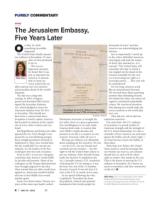
The plaque on the U.S. Embassy in Jerusalem
dedicated on Israel’s 70th anniversary in 2018.
WIKIMEDIA COMMONS