
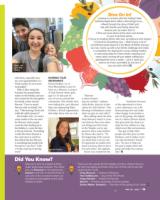

Zeev, Lihi
and Hilla
Maine
Dive On In!
Looking to connect with this holiday? Aish
Detroit’s Ayala Kohn offers a few things to try …
• Read through the story of Ruth and
talk with friends and family about the
lessons you can learn from it.
• Pick out some items at the store and donate
to your local food pantry.
• Focus on treating others with love, acceptance and respect.
• Commit to something new — Ruth shows a lot of
commitment (read about it in the Book of Ruth!), and you
can, too. Come up with a fun family challenge and make
a competition for staying the course. Eating healthy
or exercising daily for a few weeks, keeping your
room clean, turning off your tablet, calling your
grandparents once a week — pick a value you
want to be more committed to and see if
you can stick with it!
MAY 25 • 2023 | 19
Shavuot is one of Judaism’s three
major pilgrimage festivals. The other
two are Passover in the spring and
Sukkot in the fall. In ancient times, it
was one of the occasions when our
ancestors would gather at the Holy
Temple in Israel.
There are five names for the holiday, and four of them have to
do with harvesting and food. Only one of them has to do with
receiving the Torah.
Chag Shavuot — Festival of Shavuot
Yom HaBikkurim — Day of the First-Fruits
Chag Hakatzir — Festival of Harvest
Atzeret — A festive assembly of all the people
Zeman Matan Torateinu — The time of the giving of our Torah
Did You Know?
with them, especially since
my savta (grandmother) is a
Torah teacher, it’s even more
meaningful.
”
Hilla, 6, likes eating the
bourekas her grandmother
makes on the holiday, and says
she’s excited for the atmosphere
her family creates around
Shavuot. “I love to spend
Shavuot with my family,
” she
says. “I like learning Torah and
really like tefilot [prayers].
”
Her brother Zeev, 14, used a
count similar to the one used
for Shavuot, where people
count the days leading up to
the holiday, to count the days
to his bar mitzvah. “Something
I really like about Shavuot is
the count up to it, and how
that reflects the fact Shavuot
is something that people look
forward to,
” says Zeev. “I did
a 50 day count up to the big
event.
”
SHARING YOUR
ABUNDANCE
Nicole Psakhis, 12, of
West Bloomfield, is part of
Girls on a Mission, a project
of Aish Detroit where girls
ages 12-15 take part in
acts of service around the
community. This month, they
were baking for a pre-Shavuot
bake sale supporting Bikur
Cholim, a Jewish organization
that helps those who are sick.
“Shavuot
is about sustain-
ing one another,” explains
Ayala Kohn, director of edu-
cation for Aish Detroit. “Our
blessing of abundance comes
when we give to each other.”
She’s talking about the idea
from Shavuot, which is a har-
vest festival, that even when
you bring your first fruits
to the Temple, you’re sup-
posed to leave some behind
for those who need it. “It’s
the beginning of the season,
you don’t have a lot yet, but
it’s important no matter how
much you have that we leave
for each other,” she explains.
Nicole was excited for the
fundraiser because
of the opportunity to have
a new experience, see a dif-
ferent perspective and make
others happy. Last month as
part of the group, she helped
out at a Metro Detroit charity
that gives kids the chance to
shop for free clothes in a dig-
nified store-like environment.
“You get to help other
people and they pass on that
kindness, and it makes every-
one else feel better,” Nicole
says. “It’s nice to help out
because it makes them feel
good and helps the commu-
nity.”
Nicole Psakhis