

8 | MAY 18 • 2023
PURELY COMMENTARY
A ROLE MODEL
Kushner went on with his edi-
torial endeavors, serving with
author Rabbi Chaim Potok as in
writing the English commentary
for Etz Chaim, the official Torah
commentary of the Conservative
Movement that was published
in 2001. In his comments on
the text of Achrei Mot, which
was read on Shabbat the week of
his own death, Kushner wrote
… “
After the death of the two
sons of Aaron, we are drawn to
confront our own mortality and
to reflect on the direction of our
lives.
” (Etz Chaim, p 679)
Regarding his comments on
the Emor Torah portion read on
the very day of his funeral, Rabbi
Kushner wrote, “
As public fig-
ures, the Kohanim must be role
models of dealing with grief and
loss, balancing their personal
sorrow with their commitment
to serving the people and the
obligation to accept death as part
of G-d’s plan for the world.
”(Etz
Chaim, p.717)
Even in death, Rabbi Kushner’s
words continue to teach us how
to deal with the crisis of loss and
grief. Addressing life’s crises was
paramount to him. In 1977, as
his son’s health was deteriorating,
he spent a Shabbat as scholar at
my congregation. His remarks
were true to his belief in the rab-
bi’s role as helper. In his address
which was later published, he
said, “What should the goal of
a synagogue be? I would set as
your first goal, to help people
cope with the crises of life …
Helping a person through a crisis
is a mitzvah; it’s a religious man-
date of the highest order.
”
In our ongoing correspon-
dence, though we discussed
sports trivia, we also addressed
serious matters. In a letter dated
Sept. 9, 1977, he wrote, “The
summer was a kind of tense but
eventful one. Our son Aaron
became significantly sicker
last spring … We’re hoping for
the best … It is not death that
overwhelms us, but the shadow
it casts before and after, being
afraid of being haunted by it
afterwards … the only way to
deal with the fear of it is to walk
through the valley of the shadow
and come out the other side.
”
A few months after, Rabbi
Kushner wrote these words,
Aaron died at the age of 14.
Rabbi Kushner ceased all of his
public duties to focus on his
grief, his family and moving
through the valley of the shadow
as he observed the first 30-day
(Shloshim) period of mourning.
Then, too, he used words to
help others even as he helped
himself. He wrote a booklet of
tribute to Aaron. He used words
of wisdom, words of faith to
write a column in his Temple
Israel bulletin. He was the spir-
itual leader that he later wrote
of in his commentary of Emor,
balancing his personal grief with
his commitment to serving his
community.
DEALING WITH GRIEF
Even the strongest, most skilled
rabbis who effectively bring
healing to others are in need of
healing at times of their personal
life crises. Rabbis, too, need sup-
port, empathy and community
in times of great loss. We draw
on our traditions to act as balm
to the trauma of grief enabling
us to move from pain to heal-
ing, finding deep satisfaction
from our lives and appropriately
remembering those whom we’ve
lost. Rabbis who experienced
personal trauma have used their
life crisis to teach and guide their
communities. A body of books,
book chapters and articles has
evolved that deals with the per-
sonal suffering of clergy and how
they found that Jewish wisdom
gave them guidance and strength
in their time of need.
Each rabbi found a way to
emerge from a life crisis with the
capacity to adapt to a new life
reality and to direct powerful
inner forces towards the benefit
of others. Each rabbi moved
through grief in a unique way.
I cite only a few who can serve
as models. Rabbi David Wolpe
used words to respond to his
mother’s stroke and resultant
aphasia. In 1992, he wrote the
very beautiful book In Speech and
In Silence, a testament to a fami-
ly’s strength and courage. Wolpe
wrote, “Words ultimately lead to
silence — a stillness by which we
let G-d in.
”
Rabbi Ira Stone responded to
the tragic death of premature
twin sons. One son died within
days of birth, the other after a
few months. Rabbi Stone wrote,
Seeking A Path to Life (1992), a
series of meditations on sub-
jects of everyday life including
suffering. He included a med-
itation “The Messiah and the
Resurrection of the Dead.
”
POWER OF WORDS
In my own experience of crisis,
in 2006, after the loss of my
parents and only brother within
a 28-hour period, I, too, turned
to words hoping to help oth-
ers. I had previously compiled
and edited The Kaddish Minyan
(2001) and From Pain to Healing:
Twenty Personal Stories (2003)
and found these stories and
words soothing. I wrote a book
chapter, “Reflections on Saying
Kaddish” as part of the book
Kaddish (Birnbaum, D & Cohen,
M., ed) and articles including
“28 Hours: Rabbi Endures Death
of His Elderly Parents as Well
as Unexpected Death of His
Brother” which was published
in the Detroit Jewish News (May
2006).
I turned to the words about
which I wrote, the Kaddish
prayer and faithfully recited it at
minyan every day for 11 months.
These words gave me strength.
With each Kaddish I envisioned
my family standing at my side.
Words and Jewish wisdom
provide strong messages. These
have been the essentials in the
toolbox of spiritual leaders. We
try to be true to the words as
written by Rabbi Kushner, serv-
ing as “role models of dealing
with grief and loss as we balance
our personal sorrow.
”
Rabbi Wolpe, Rabbi Stone
and I have been blessed to guide
and assist thousands of people
during times of their life crises.
enabling them to maintain faith
in G-d and a relationship with
G-d. Rabbi Harold Kushner, z”l,
exceeded all of us in reaching
millions around the world with
his words, his wisdom and his
example.
Herbert A. Yoskowitz, is Rabbi Emeritus
of Adat Shalom Synagogue in Farmington
Hills, Michigan.
continued from page 6
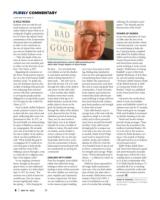
Rabbi Harold Kushner and his 1981 bestselling book
When Bad Things Happen to Good People
RON BULL/TORONTO STAR VIA GETTY IMAGES/JTA