

54 | MAY 11 • 2023
T
he first reference to Israel out-
side the Hebrew Bible is on the
Merneptah stele, a slab of black
granite engraved in the days of Pharaoh
Merneptah, successor to Ramses II, the
man some scholars iden-
tify as the Pharaoh of the
Exodus. It says, “Israel is laid
waste; her seed is no more.”
The first reference to Israel
outside the Bible is an obitu-
ary. Israel’s enemies thought
it was dead. More than 32
centuries, half the history
of civilization, later, we can still say “Am
Yisrael Chai, the Jewish people lives.”
Not only Jews, but people like Blaise
Pascal, Jean-Jaques Rousseau and Leo
Tolstoy, saw in this survival something
miraculous, as if an invisible hand had
written out of the lives of Jews across the
generations a story about human pos-
sibility, about a journey from slavery to
freedom across a great wilderness of space
and time to a land of promise and hope.
How did a people survive for 20 centu-
ries without a state, a home, a place where
they could defend themselves? How did
they sustain their identity when every-
where they were a minority? How did faith
survive the massacres and pogroms, when
Jews called and heaven seemed silent?
That’s what astonished Pascal, Rousseau
and Tolstoy before the 20th century.
But today the question is so much
deeper. How could a people ravaged by
the Holocaust survive that trauma and
put their faith in life again? How could a
nation that had not known independence
or sovereignty for 2,000 years take it up
again? How could they, with so little,
build a land, a state, a society, a culture,
that has achieved so much?
How, under constant threat of war and
terror, surrounded by enemies pledged to
their destruction, could they sustain a free
and democratic society in a part of the
world that had never known it; create an
economy with outstanding achievements
in agriculture, science, medicine and
technology; produce a culture rich in art
and music, poetry and prose?
How out of the most diverse popula-
tion could they shape an identity? How
could they build not only great secular
universities but also thriving yeshivot, so
that the words of Isaiah could come true
in our time, that “Torah will come forth
from Zion and the word of the Lord from
Jerusalem.” How, so soon after the night-
mare, could they realize so many dreams?
Somehow, in ways I don’t fully under-
stand, the Jewish people has been touched
by a power greater than ourselves, that’s
led our ancestors and contemporar-
ies, time and again, to defy the normal
parameters of history. Somehow heaven
and earth met in the Jewish heart, lift-
ing people to do what otherwise seemed
impossible. Descartes said: I think, there-
fore I am. The Jewish axiom is differ-
ent. Ani maamin, I believe, therefore I am.
It was the most haunting of all prophetic
visions. The prophet Ezekiel saw a valley of
dry bones, a heap of skeletons. God asked
Read this excerpt from Rabbi Sacks’
“Home of Hope,” which was re-released
to mark Israel’s 75th anniversary.
Israel:
The Home of Hope
Rabbi Lord
Jonathan
Sacks
SPIRIT
A WORD OF TORAH
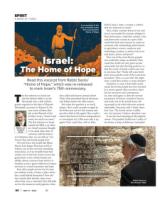
Rabbi Sacks at
the Western Wall
A screenshot of the
new animated video
that accompanies
Home of Hope
“HOW COULD A
PEOPLE RAVAGED
BY THE HOLOCAUST
SURVIVE THAT TRAUMA
AND PUT THEIR FAITH
IN LIFE AGAIN?”
— RABBI LORD JONATHAN SACKS