

MAY 4 • 2023 | 33
as an adjunct professor at University of
Detroit Mercy from 2008-2012, and then
at University of Michigan Law School from
2018 onwards, where he continues to teach
today.
At the latter, he created the course “21st
Century Infrastructure: The Lawyer’s Role,
”
which covers infrastructure history and
related legal and ethical issues.
MAKING A PIVOT
As a topic he’s now intimately familiar with,
Doctoroff put his high-profile legal career
on hold to pivot to a role in public service
— specifically, infrastructure and its legal
issues.
The reason? At 47, Doctoroff was thrown
an unexpected curveball. He underwent
heart surgery and, with both of his parents
passing away early, realized how limited
time could be.
“I started playing with the idea of doing
something different after recovering from
heart surgery,
” he recalls. “I didn’t really
have anything great in mind because I didn’t
want to leave a good career that was still
improving and growing stronger.
”
He had been a partner at Honigman for
more than a decade. However, after chairing
a State Bar committee on business courts
that generated a report that made its way
across former Gov. Snyder’s desk, Snyder
asked Doctoroff if he wanted to help advo-
cate the creation of a statewide business
court in Michigan.
The effort was successful, so much so
that it encouraged Doctoroff to write a brief
email to the office of the legal counsel with
whom he was working with to ask if they
would want to use him. “I was interested in
public service,
” he admits.
Ten minutes later, a reply hit Doctoroff’s
inbox. “They really needed someone to
lead Michigan’s participation in the bridge
effort,
” he recalls. “When I got the opportu-
nity to be the bridge guy, I finally jumped at
it, and I’ve never looked back.
”
LOOKING FORWARD
As for his next steps following the com-
pletion of the Gordie Howe International
Bridge, Doctoroff is still mulling over his
options. Outside of his work, he enjoys
spending time with his family — his wife
Stacy, a licensed therapist he calls his “north
star,
” and his three children Nicole, Alana
and Matthew.
“I feel really lucky to be able to say that
we are all very fond of each other,
” he jokes.
“We’ve got a very close family.
”
Doctoroff is also one of four brothers and
has an identical twin, Tom. While he figures
out where the rest of his career will take
him, he calls the ongoing project the biggest
“bridge-building” effort of all.
“We overcome differences and see things
from competing perspectives,
” Doctoroff
says. “There are so many viewpoints that
have to be reconciled to achieve a common
shared goal: creating this state-of-the-art,
once-in-a-generation international bridge
that’s going to change the economy of this
region.
“In order to do that,
” he adds, “it’s neces-
sary to build bridges.
”
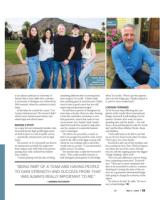
Nicole, Stacy,
Andrew,
Matthew and
Alana Doctoroff.
Andy
Doctoroff
“BEING PART OF A TEAM AND HAVING PEOPLE
TO GAIN STRENGTH AND SUCCESS FROM, THAT
WAS ALWAYS REALLY IMPORTANT TO ME.”
— ANDREW DOCTOROFF