

continued on page 78
Alan Muskovitz: Your grandfather
was the legendary Indian painter
Francis Newton Souza and your
mother is an accomplished artist in
Israel. Painting is truly in your DNA.
Solomon Souza: Definitely. I came
from a family of artists. It was engrained
within me from a very young age. I real-
ized I could draw and paint. It spoke to
my soul. I continued to grow into it. It
was something I had to do.
I understand you even drew on the
walls in your house as a young boy.
Yes, drawing on walls everywhere
and my mum, instead of stopping me,
she would just put paper on our walls
that were my height that I could draw
and paint on.
Later, as you began reaching your
teens, you entered a school that was
known as a “last chance place for
boys who had been expelled from
other programs.” A bit of a “wild
child” perhaps?
You could say that. The school was
a yeshivah near Jerusalem. A lot of my
friends were there, and I fell in love
with it. It became my family.
What was it about this particular
school that finally changed the tra-
jectory of your life?
It changed my life in so many ways.
It gave me the structure I needed, but
unlike most other schools, they didn’t
dictate to you. It gave me the flexibility
to explore and discover who I really
wanted to be.
So you weren’t kept on a tight leash,
so to speak?
Exactly. It was an accepting place,
and they gave me the room to do any-
thing I wanted, including painting a
bunch of rooms in the yeshivah, eventu-
ally branching out to paint in the streets.
And what if you hadn’t been given
that flexibility, if you had to conform
more?
I’d be a rabbi now. Most of my
friends became rabbis and run their
own yeshivahs. I even attend a shul
today run by a friend. It’s wonderful.
You’re a painter and not a rabbi. But
you share so many stories from the
Torah in your art. Judaism truly plays
a central role in your life.
I have a deep love and respect for
Judaism as a religion, and I’m deeply
connected to the culture. I’m shomer
Shabbos. I keep kosher. I observe the
holidays. I’m as some say Masorti — a
traditional Jew.
You were only 8 years old when your
grandfather, acclaimed artist Francis
Newton Souza, passed away and you
didn’t have many opportunities to be
with him. To what degree has his leg-
acy impacted you?
I grew up in awe of him. The more I
understood, the more I learned about
the role he played in India art, the
more I was amazed by him, wowed
by him. It inspired me to push myself
more, take my art and craft more seri-
ously.
In 2019, you were invited to paint
in the Serendipity Arts Festival in
Goa, the birthplace of your grandfa-
ther. What kind of reception did you
receive?
It was quite amazing. I painted 20
murals telling the untold stories of
Goa’s heroes. They treated me as if I
were my grandfather. It was because
of him that I was there, and I was so
thankful and felt incredible gratitude.
It cannot be fully appreciated by
a mere passing glance. The mural
is an exhilarative 60’ x 6’ expanse
that takes up an entire wall of the
gallery’s lower gallery. A “creation”
that leaves you spellbound in both
the literal and biblical sense.
Solomon graciously set aside
time after completing the mural
to talk one-on-one. On Friday
afternoon prior to the Sunday
exhibition opening, we took
advantage of the unseasonably
warm temperatures to share a
memorable conversation while
perched outside on the steps of
the JCC (see sidebar on this page).
Meanwhile, as we chatted, the
inside of the gallery was a flurry
of activity as crews led by Janice
Charach Gallery Director Natalie
Balazovich and Assistant Director
Rebecca Reeder worked tirelessly
to put the finishing touches on
the exhibit. Balazovich is in her
11th year at the gallery and is
herself an artist who has taught
drawing at the Frankel Jewish
Academy.
A CULTURAL
COLLABORATION
The Souza and Jezreel exhib-
its are the result of months of
strategizing between the gallery,
JCC and organizations within
Metro Detroit’s Jewish and Asian
Pacific communities, resulting
in the main co-sponsorships of
Solomon’s visit by the Jewish
Federation of Metropolitan
Detroit (JFMD) and the Asian
Pacific Islander American Public
Affairs Association-Michigan
(APAPA-MI).
Natalie Charach, mother of
the late Janice Charach, Natalie’s
sisters Esther Hankin and Doris
Shulman, and a relative of the
Charach family, Judy Pearl,
provided additional sponsorship
support.
JFMD and APAPA-MI each
viewed Solomon’s unique Indian-
One-on-One with
Solomon Souza
ALAN MUSKOVITZ
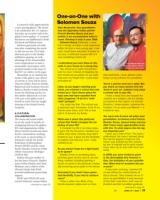
Alan Muskovitz and
Solomon Souza share a
moment by the mural.
APRIL 27 • 2023 | 77
continued on page 78
JERRY ZOLYNSKY