

continued on page 48
Although the congregation has
offered the option for almost
five years, this is the first year
they have had teens opting for
the inclusive version. Greene
said that the congregation also
has teens who have transitioned
after their b’nai mitzvah. He
estimates that they have five-
to-seven teen congregants who
identify as trans or genderqueer,
meaning they do not identify
with the gender they were
assigned at birth.
MIRRORING THE
TRADITIONAL
B’mitzvahs at Har Hashem
mirror the traditional gendered
ceremonies in everything
but language. “We have folks
that don’t feel like a ‘ben’ or a ‘bat,’”
said Greene, using the Hebrew words
meaning “son” and “daughter.”
“So we come up with other Hebrew
terms, [such as] ‘beit,’ which is from
“the house of [parent name].” He said
that a number of changes can be made
to the Hebrew to increase inclusivity,
ranging from the creation of new terms
to using the infinitive version of words
that would otherwise be gendered.
“We’re not treating anybody any
differently, other than being sensitive to
their needs,” he said.
Ruby Marx, a 16-year-old who uses
she/her pronouns, had a gender-neutral
b’mitzvah with Temple Beth Zion in
the Boston area in early 2020, pre-
pandemic. “I always knew that I was
gonna have to have [a b’nai mitzvah].
But when it came time to start thinking
about it, I was like, ‘I really don’t feel
comfortable having a bat mitzvah.’
But I wasn’t comfortable [having a bar
mitzvah], either. So someone suggested
that I do something in the middle. And
that felt right for me.”
Marx, who describes herself as
gender-fluid, was the first teen in her
congregation to have a ceremony that
didn’t fall within either the bar or
bat categories. In the years following,
several other teens in her community
have had gender-neutral ceremonies,
including one who had a ceremony in
mid-March.
“I don’t think anyone else had done
something like that before,” said Marx.
“I think a lot of other kids started to
feel comfortable being like, ‘Oh, maybe
that’s something I would want to do,’
or incorporating different things that
they’re passionate about [into their
ceremonies].”
For her ceremony, she wore a prayer
shawl featuring rainbow trimming and
various rock n’ roll patches from her
favorite bands. Marx said that the most
rewarding part of her experience has
been being a trailblazer for inclusion
in her congregation. “It definitely feels
good to know that I can help other kids
feel comfortable being who they are,
because I know that sometimes I’m not
always comfortable being who I am. It’s
nice to know that kids can look up to
me,” she said.
COMING-OF-AGE RITUAL EVOLVES
Gender inclusion in b’nai mitzvahs has
been expanding for decades, beginning
with the American introduction of the
bat mitzvah in 1922 for the daughter of
Rabbi Mordecai Kaplan, the founder of
Reconstructionism, in New York City.
Before that, only boys were allowed
to engage in the important coming
of age tradition. After Judith Kaplan’s
ceremony, the custom slowly spread
across the country in non-Orthodox
synagogues. For decades, however, the
ceremonies for girls differed from those
offered to boys: In many synagogues,
girls were not allowed to read from
the Torah, and their services were held
on Friday nights rather than
Saturday mornings. Orthodox
synagogues were slow in
accepting the bat mitzvah, and
still maintain strict gender roles
in synagogue.
As feminism progressed
both outside and within Jewish
communities, girls pushed
to be allowed to read from
the Torah and to be counted
toward a minyan, the 10-person
quorum required for public
prayer. Full bat mitzvahs became
an accepted norm. A similar
pattern is now occurring for
b’mitzvahs.
As a coming-of-age ritual,
b’nai mitzvahs occupy a unique
role in Jewish life. Their goal
is to integrate young Jews into
the broader community, signaling that
they have the knowledge and maturity
to take on adult ritual responsibilities.
Because of this, many young trans
Jews wish to have a ceremony that
will fully reflect them as they become
more involved in their community and
beyond.
Brave, the Colorado teen, chose to
have their ceremony gender-neutral to
ensure it still fit them down the road.
“I don’t really know what I’m going
to identify as in the future, because
identity is fluid. And while I may be
comfortable right now with being closer
to a male identity, [later] I might be less
comfortable with that,” they said.
Marx, the gender-fluid teen outside
of Boston, said entering the community
as her authentic self was an integral part
of her choice. “I had grown up watching
all my cousins, and then my sister, have
[ceremonies]. Afterwards, they were a lot
more independent in their Jewish identity.
That was something that appealed to me,
because I wanted to be connected to the
Jewish community, but I wanted to do it
in my own way,” said Marx.
B’mitzvahs aren’t the only gender-
inclusive ceremony offered now. Many
Reform congregations have also created
ceremonies for gender transitions,
Hebrew name changes and coming
out, often based on a curriculum
offered by the Central Conference
of American Rabbis. “These are holy
moments of growth and transformation,
COURTESY PAMELA JOY PHOTOGRAPHY
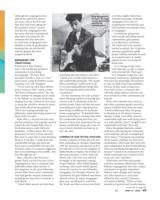
Ruby Marx playing
the guitar during a
benefit concert she
held for her
mitzvah project.
APRIL 27 • 2023 | 47