

10 | APRIL 27 • 2023
opinion
Transitions Can Be Hazardous
for the Health of the Jewish People
T
he transitional period
during which the
omer is counted
that follows the festival
of Passover and leads to
Shavuot should
be considered a
festive interlude.
We are
proceeding from
redemption
from Egypt to
the revelation
at Mount Sinai,
setting the
Jewish people on a path with
principle and purpose for the
future. In fact, Nachmanides
likens this time to hol
ha-moed — the intermediate
days of rejoicing between
festival days.
Yet, historically, this period
has become associated with
tragedy and mourning,
primarily because of the
talmudic story of the death of
the 24,000 disciples of Rabbi
Akiva. All agree that these
students died as punishment
because they did not respect
one another as they should,
though some blame plague and
others the Bar Kochba revolt.
This association
between the 49 days of
sefirat ha-omer (counting
of the omer) and trauma is
not coincidental — because
transitions are hazardous.
In the biblical story, the
Children of Israel are in a
very vulnerable position
during the period after
their Exodus from Egypt.
Following their initial
exuberance, the people must
then settle into the difficult
existence of desert life.
Inspiration evaporates in
the heat of the desert and
is replaced by thirst and
hunger. Passions run high
and there is one incident after
another: complaints about
food and water, nostalgia for
Egypt, attacks on leadership,
the unprovoked attack by
Amalek and ultimately the
sin of the golden calf.
The people need some
framework to maintain the
cohesion and solidarity in
order to survive the ongoing
challenges of the wilderness.
Moses striking a rock and
interceding with God —
relying on the stature of one
individual to “make things
right” — is not a long-term
solution.
Politically, as well, the
people are in limbo. With
their redemption, they have
shaken the heavy yoke of
their Egyptian taskmasters,
but they have not yet received
the Torah at Sinai. They have
political freedom without
law — i.e. the institutions
and governing framework a
society needs to function.
This is a very precarious
place to be. Freedom without
the responsibilities and
boundaries of the law is
not sustainable and can too
quickly degenerate into a
state of anarchy in which
“everyone did that which was
right in his own eyes.” (Judges
21: 25)
The trepidation and
foreboding which have come
to characterize the period
of sefirat ha-omer resonates
greatly during the current
circumstances today in the
State of Israel. We too are in a
state where we seem to enjoy
political freedom without the
grounding of a clear set of
laws that provide guideposts
and stability in our society.
This impending chaos exposes
us to internal discord as well
as external threats.
We have secured political
freedom during the first
75 years of the state, at a
significant price in terms
of blood, sweat and tears.
Yet, like the Children of
Israel plodding through
the desert before arriving
at Sinai, we see that is not
enough. We are in need of
a contemporary equivalent
of Sinai to consolidate and
preserve our freedom and
forge a just and secure
society which will not only
survive but thrive.
As we lead up to Shavuot,
it is also worth examining
what happened at Sinai and
how this fractious people was
brought together.
All stood together, saw
the fire and smoke of the
mountain and heard the
laws being commanded.
They shared a formative
experience that involved
everyone present, and they all
responded in unison, na’aseh
v’nishma, we will do
and we will understand.
This consensus forged a
peoplehood that endured,
even though challenges
continued to arise.
We should think about
the current push for legal
reforms in this context. Our
biblical history makes the
case for the importance of
a legal framework to shape
the contours of our freedom
and to provide clear ground
rules for society. We also see
the need for consensus to
launch such a grand national
enterprise, where there is
active buy-in and acceptance
is broad based.
As Israelis — secular,
religious, left, right, Jew and
non-Jew — we all need to be
concerned. Rushing through
a set of legal reforms without
first achieving the kind of
national unity modeled at
Sinai — solidarity that we
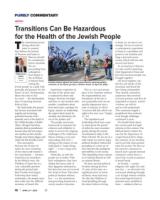
Israelis protest against the Israeli government’s planned judicial
overhaul, at the Goma junction, northern Israel, on April 15, 2023.
AYAL MARGOLIN/FLASH90
PURELY COMMENTARY
Rabbi Herzl
Hefter
Times of
Israel