

24 | APRIL 20 • 2023
S
ome educators
leave a legacy to
their students.
History teacher Gennadiy
Grigorievich Bosovets of
David-Horodok in Belarus
takes it one
inspirational
step further.
He initiated the
creation of a
monument in
remembrance
of the Jewish
descendants of
David-Horodok
in the town square.
Many of the descendants
today, fondly known as
David-Horodokers, live in
Metro Detroit. The Detroit
David-Horodok Organization
has 600 families on the
mailing list, while the Israeli
David-Horodok Organization
has 200. Both groups
include members worldwide
and include second- and
third-generation Holocaust
survivors. David-Horodok,
Davyd-Haradok and David-
Goradok are just some of the
spellings of the town.
According to the website
Shtetl Routes, the city was
named after Prince David,
grandson of Yaroslav the
Wise and founded in 1100
with Jews settling in the
1500s. The Jewish community
flourished in the 1800s, with
three synagogues. Due to
pogroms and antisemitism
in Russia, many of the
descendants left during the
late 1800s and continued to
leave until 1939.
From 1921 to 1939,
David-Horodok was part of
Poland, and afterwards the
city became part of Russia.
The Nazis entered the town
in 1941 and shot 7,000 men,
women and children in the
forest. When the Soviets
entered the town in 1944,
no Jews were left in David-
Horodok.
Today, there are no Jewish
residents in the city.
But the memory of the
Jewish presence is alive,
thanks to historians and
David-Horodokers. At the
mass grave site, there is a
monument established by
the Israeli organization in
2009. Bosovets teaches his
students about the area.
When he noticed the path to
the memorial was difficult for
visitors to reach, he conceived
the idea to construct another
sculpture in the city center.
This project was funded by
both the Detroit and Israeli
organizations of descendants
of David-Horodok.
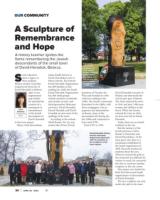
The new sculpture not only
marks the path to the mass
A Sculpture of
Remembrance
and Hope
OUR COMMUNITY
A history teacher ignites the
flame remembering the Jewish
descendants of the small town
of David-Horodok, Belarus.
The wood
and granite
sculpture, by
local artisan
Sergey Zhilevich,
has a carving
of a father and
son on one side
and a mother
and daughter
on the other.
David-Horodok history
teacher Gennadiy
Grigorievich Bosovets
with his students at
the sculpture in the
town square.
Carla
Schwartz
Contributing
Writer