

8 | MARCH 30 • 2023
opinion
Which side are you on: Jewish American
or American Jew?
E
arlier this month the New
York Times convened
what it called a “focus
group of Jewish Americans.
”
I was struck briefly by that
phrase — Jewish
Americans — in
part because
the Times, like
the Jewish
Telegraphic
Agency, tends to
prefer “
American
Jews.
”
It’s seemingly a distinction
without a difference, although
I know others might disagree.
There is an argument that
“
American Jew” smacks of
disloyalty, describing a Jew
who happens to be American.
“Jewish American,” accord-
ing to this thinking, flips the
script: an American who hap-
pens to be Jewish.
If pressed, I’d say I prefer
“
American Jew.” The noun
“Jew” sounds, to my ear any-
way, more direct and more
assertive than the tentative
adjective “Jewish.” It’s also
consistent with the way JTA
essentializes “Jew” in its cov-
erage, as in British Jew, French
Jew, LGBT Jew or Jew of color.
I wouldn’t have given
further thought to the sub-
ject if not for a webinar last
week given by Arnold Eisen,
the chancellor emeritus
at the Jewish Theological
Seminary. In “Jewish-
American, American-Jew:
The Complexities and Joys of
Living a Hyphenated Identity,”
Eisen discussed how a debate
over language is really about
how Jews navigate between
competing identities.
“What does the ‘
American’
signify to us?” he asked.
“What does the ‘Jewish’ sig-
nify and what is the nature of
the relationship between the
two? Is it a synthesis? Is it a
tension, or a contradiction, or
is it a blurring of the bound-
aries such that you can’t tell
where one ends and the other
begins?”
Questions like these, it
turns out, have been asked
since Jews and other immi-
grants first began flooding
Ellis Island. Teddy Roosevelt
complained in 1915 that “there
is no room in this country
for hyphenated Americans.”
Woodrow Wilson liked to say
that “any man who carries a
hyphen about with him carries
a dagger that he is ready to
plunge into the vitals of the
Republic.” The two presidents
were frankly freaked out about
what we now call multicultur-
alism, convinced that America
couldn’t survive a wave of
immigrants with dual loyalties.
The two presidents lost the
argument, and for much of
the 20th century “hyphenated
American” was shorthand
for successful acculturation.
While immigration hardliners
continue to question the loy-
alty of minorities who claim
more than one identity, and
Donald Trump played with the
politics of loyalty in remarks
about Mexicans, Muslims
and Jews, ethnic pride is as
American as, well, St. Patrick’s
Day. “I am the proud daughter
of Indian immigrants,” former
South Carolina Gov. Nikki
Haley said in announcing
her run for the Republican
presidential nomination this
month.
For Jews, however, the
hyphen became what philos-
ophy professor Berel Lang
called “a weighty symbol of
the divided life of Diaspora
Jewry.” Jewishness isn’t a dis-
tant country with quaint cus-
toms, but a religion and a por-
table identity that lives uneas-
ily alongside your nationality.
In a 2005 essay, Lang argued
that on either side of the
hyphen were “vying traditions
or allegiances,” with the Jew
constantly confronted with a
choice between the American
side, or assimilation, and the
Jewish side, or remaining dis-
tinct.
Eisen calls this the “ques-
tion of Jewish difference.”
Eisen grew up in an observant
Jewish family in Philadelphia,
and understood from an early
age that his family was differ-
ent from their Vietnamese-,
Italian-, Ukrainian- and
African-American neigh-
bors. On the other hand, they
were all the same — that is,
American — because they
were all hyphenated. “Being
parallel to all these other dif-
ferences, gave me my place in
the city and in the country,”
he said.
In college he studied the
Jewish heavy hitters who
were less sanguine about the
integration of American and
Jewish identities. Eisen calls
Rabbi Mordecai Kaplan, the
renegade theologian at JTS,
“the thinker who really made
this question uppermost for
American Jews.” Kaplan wrote
in 1934 that Jewishness could
only survive as a “subordinate
civilization” in the United
States, and that the “Jew in
America will be first and fore-
most an American, and only
secondarily a Jew.”
Kaplan’s prescription was a
maximum effort on the part of
Jews to “save the otherness of
Jewish life” — not just through
synagogue, but through a
Jewish “civilization” expressed
in social relationships, leisure
activities, and a traditional
moral and ethical code.
Of course, Kaplan also
PURELY COMMENTARY
Andrew
Silow-Carroll
JTA
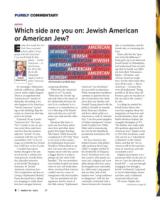
JTA illustration by Mollie Suss
continued on page 10