

74 | MARCH 30 • 2023
T
he institution of the haftarah
— reading a passage from the
prophetic literature alongside the
Torah portion — is an ancient one, dating
back at least 2,000 years. Scholars are not
sure when, where and why it was instituted.
Some say that it began when Antiochus
IV’s attempt to eliminate Jewish practice in
the second century BCE sparked the revolt
we celebrate on Chanukah.
At that time, so the tradition
goes, public reading from
the Torah was forbidden.
So, the Sages instituted that
we should read a prophetic
passage whose theme would
remind people of the subject
of the weekly Torah portion.
Another view is that it was introduced
to protest the views of the Samaritans,
and later the Sadducees, who denied the
authority of the prophetic books except the
book of Joshua.
The existence of haftarot in the early
centuries CE is, however, well attested.
Early Christian texts, when relating to
Jewish practice, speak of “the Law and the
Prophets,
” implying that the Torah (Law)
and haftarah (Prophets) went hand-in-
hand and were read together. Many early
Midrashim connect verses from the Torah
with those from the haftarah. So, the
pairing is ancient.
Often the connection between the
parshah and the haftarah is straightforward
and self-explanatory. Sometimes,
though, the choice of prophetic passage
is instructive, telling us what the Sages
understood as the key message of the
parshah.
Consider the case of Beshallach. At the
heart of the parshah is the story of the
division of the Red Sea and the passage of
the Israelites through the sea on dry land.
This is the greatest miracle in the Torah.
There is an obvious historical parallel. It
appears in the book of Joshua.
The river Jordan divided, allowing the
Israelites to pass over on dry land: “The
water from upstream stopped flowing. It
piled up in a heap a great distance away
… The Priests who carried the Ark of
the Covenant of the Lord stopped in the
middle of the Jordan and stood on dry
ground, while all Israel passed by until the
whole nation had completed the crossing
on dry ground.
” (Josh. ch. 3).
This, seemingly, should have been the
obvious choice as haftarah. But it was not
chosen. Instead, the Sages chose the song of
Devorah from the book of Judges. This tells
us something exceptionally significant: that
tradition judged the most important event
in Beshallach to be not the division of the
sea but rather the song the Israelites sang
on that occasion: their collective song of
faith and joy.
This suggests strongly that the Torah is
not humanity’s book of God but God’s book of
humankind. Had the Torah been our book
of God, the focus would have been on the
Divine miracle. Instead, it is on the human
response to the miracle.
So, the choice of haftarah tells us much
about what the Sages took to be the
parshah’s main theme. But there are some
haftarot that are so strange they deserve to
be called paradoxical because their message
seems to challenge rather than reinforce
that of the parshah. One classic example
is the haftarah for the morning of Yom
Kippur, from the 58th chapter of Isaiah,
one of the most astonishing passages in the
prophetic literature:
“Is this the fast I have chosen — a day
when a man will oppress himself? … Is this
what you call a fast, ‘a day for the Lord’s
favor?’ No: This is the fast I choose. Loosen
the bindings of evil and break the slavery
chain. Those who were crushed, release
to freedom; shatter every yoke of slavery.
Break your bread for the starving and bring
dispossessed wanderers home. When you
see a person naked, clothe them: do not
avert your eyes from your own flesh.
” (Is.
58:5-7)
The message is unmistakable. The
commands between us and God and those
between us and our fellows are inseparable.
Fasting is of no use if at the same time
you do not act justly and compassionately
to your fellow human beings. You cannot
expect God to love you if you do not act
lovingly to others. That much is clear.
But to read this in public on Yom Kippur,
immediately after having read the Torah
portion describing the service of the
High Priest on that day, together with the
command to “afflict yourselves,
” is jarring
Rabbi Lord
Jonathan
Sacks
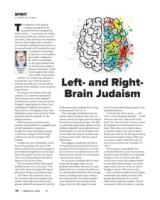
Left- and Right-
Brain Judaism
SPIRIT
A WORD OF TORAH