

MARCH 30• 2023 | 7
P
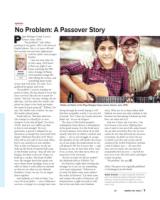
ikpa Refugee Camp, Lesvos,
Greece. June, 2016.
“No problem?” asks Sahar,
pointing at my guitar. This is her favorite
English phrase. She is 14 years old and
has recently arrived from Afghanistan
with her father and younger
brother.
I am not sure why I’m
in this camp. All I know
is that one night I was
home watching the PBS
news, footage of flimsy
overcrowded orange life-
rafts filling the screen, and
something deep inside
of me said, lech lecha. Go unto. So, I
grabbed my guitar and went.
“No problem”, I answer, handing my
guitar to Sahar. She has played it every day
since I arrived. She asks me to teach her
chords. “Sad one,” she says, smiling. On the
fifth day, I ask her about her mother. She
points her finger to her head and makes
the sound of a gun going off. “Taliban,” she
says. Her mother was a teacher, she says.
Her mother played guitar.
Torah tells us, “and thou shalt love
(the stranger) as thyself; for ye were
strangers in the land of Egypt” (Leviticus
19:34). And yet, our rabbis say that
to love is not enough: “In every
generation, a person is obligated to see
themselves as though they came forth from
Egypt.” (Mishnah Pesachim 10:5) These
texts tell us not only to love each other,
but to see ourselves as one another.
This is why, on Passover, we do not
hold up the bowl of matzoh ball soup
or the brisket and say, “may all who are
hungry, let them come eat.” Nope, we
hold up a cracker: the bread of afflic-
tion, the meager food that marks our
own release from bondage. Even as we
offer to share it with others it reminds
us that we are what we eat: Matzoh.
Freedom. Come, we say. Let us ingest
these together.
And suddenly, as I look at Sahar, I see
every bit of my father — once a Holocaust
survivor, a stranger in a strange land, wan-
dering through the world, hoping it will
find him acceptable, worthy. I see every bit
of myself. “Yes,” I hear my recently deceased
father say, “we are all refugees.”
The story of the Jewish people’s
redemption from slavery is foundation-
al for good reason: it is the lived story
of every human. Even those of us, like
myself, who live in relative comfort and
safety — do we not struggle to escape
the shackles of our self-doubt, the tyran-
ny of our pride, the enslavement to our
cell phones? We live it every day — and
because we do, we love that story. And
if we, as Jews, love that story, then we
must love it for everyone.
“Do not set aside one life for another”
the Mishnah tells us (Ohalot 7:6).
On Passover, right after inviting the
stranger in to eat, we say something
even more important: “Whoever is
in need, let them come and conduct
the seder of Passover.” Let them come
and conduct the seder of Passover. All
humans have a right not only to tell,
but to live out their own freedom
story. Who are we to deny Sahar that?
Indeed, we must not only confirm it, but
because our becoming is bound up with
hers, we must aid in it.
And now I know why I am here. I am
here because I am a Jew. Fighting back
tears I want to run out of the camp toward
the sea that carried her here, the sea not
unlike the one that delivered my ancestors
to freedom, my father to Israel, the sea
in which I can dive and scream and be
washed of the world’s brokenness. Instead,
I look in Sahar’s eyes — the ones that
have seen too much, the ones that are
inseparable from my own — and tell her
how sorry I am. She looks down and begins
to play my guitar.
“No problem,” she says.
(Note: This piece was originally published
in Washington Jewish Week)
Robbie Schaefer is a singer-songwriter, theatre/film
artist, and rabbinical student at Pluralistic Rabbinical
Seminary. His first film, Burst the Silence, will be
released by Rolling Pictures in 2023. Also, he likes
olives. A lot.
Robbie
Schaefer
The Times of
Israel
opinion
No Problem: A Passover Story
Robbie and Sahar at the Pikpa Refugee Camp, Lesvos, Greece, June, 2016.
PIPPA SAMAYA