

MARCH 30 • 2023 | 45
continued on page 46
A WORLD OF
DIFFERENCE
In the British territory of
Gibraltar off Spain, brick dust
is mixed into the charoset,
according to beliefnet.com.
Chasidic Jews in Poland pour
water on the floor to resemble
crossing the Red Sea, raising
a glass with each metaphoric
town they reach. Afghani
Jews use scallions or leeks
to represent the Egyptian
slavedrivers’ whips, and in
Ethiopia, they destroy earth-
enware dishes to symbolically
make a break from the past.
You’ll find the host walk-
ing around the table three
times with the seder plate
while tapping a blessing on
their guest’s heads in Spain,
Morocco and Turkey. Families
perform skits in full costumes
in North Africa, according
to Myjewishlearning.com. At
Syrian seders, they turn the
middle matzah into letters
that add up to 10 for the Ten
Plagues, and in Marrakesh,
foods are made from the wine
in Elijah’s cup.
The resettlements during
the Middle Ages are responsi-
ble for splitting Jewish people
into different geographic
and cultural groups. The
descendants of Northern and
Eastern Europe now identify
as Ashkenazi, which is the
prominent ancestral group
in the United States. Families
from the Iberian Peninsula of
Spain are known as Sephardic
and live across North Africa,
Southern and Eastern Europe
and Western Asia.
Both groups would adjust
to new places by utilizing
found indigenous items for
religious celebrations. As a
result, it made changes to
some symbolic props along
the way, but the religious
components remain the same.
In today’s world, advance-
ments in technology are mak-
ing global communication
easier, travel more accessible
and international relocations
possible. As a result, we are
connecting more, sharing
ideas and even marrying
Jewish people from other
cultures.
For example, the
Department of Homeland
Security states that more than
87,000 Israelis became citi-
zens or permanent U.S. resi-
dents between 2006 and 2016.
But there is movement both
ways. About 4,000 U.S. Jews
relocated to Israel in 2021, up
24% from the previous year,
according to Haaretz.com.
MELDING OF TRADITIONS
Closer to home, a friend’s
daughter recently married
someone from Spain, where
the Jewish community is pre-
dominantly Sephardic. The
new son-in-law’s seder will
feel the same as home, but the
foods will be different. Where
he’s from, they eat kitniyot on
Passover — since the 13th
century, the Ashkenazim have
not.
Kitniyot includes beans,
rice lentils, corn, peas, soy-
beans and several seeds, like
sesame, poppy or mustard.
Both denominations prohibit
leavened grains, unless in
matzah form.
New global dynamics like
these are creating the need to
incorporate our cultural tra-
ditions to successfully blend
our families. The inclusion of
kitniyot could be an annual
issue for culturally diverse
families on Passover. For
these reasons, there was rising
interest to review the histor-
ic rule for Passover by the
Rabbinical Assembly of the
Conservative Movement.
In April 2016, their contro-
versial vote put an end to the
nearly 1,000-yearlong ban of
kitniyot for Conservative Jews
during Passover. The change
is giving families a chance to
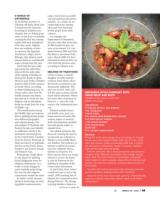
SEPHARDIC-STYLE CHAROSET WITH
DRIED FRUIT AND NUTS
Adapted from seriouseats.com
Makes 4½ cups
Ingredients:
1½ cups dry red wine, such as Merlot
1 tsp. orange juice
1 pound raisins
8 oz. packed, pitted Medjool dates, chopped
4 oz. dried apricots, chopped
½ tsp. ground cinnamon
¼ tsp. ground cloves
Kosher salt
8 oz. unsalted roasted almonds
Method:
Bring the wine and orange juice to simmer in a large
sauce pan over medium heat, then stir in fruit, cinna-
mon and cloves. Cook uncovered until fruit is hydrat-
ed and wine is absorbed, about 5 minutes. Season
with salt to taste and set aside.
Put the almonds into a food processor and pulse to
roughly chop. Remove and place into a large mixing
bowl. Add the fruit mixture to processor and pulse
until it starts to form a paste, about 3 to 5 one-second
pulses. Do not over process, leaving some chunks of
fruit intact.
Transfer the fruit to the bowl with almonds and mix
well to combine, adding more salt if needed.
Allow to sit for two hours and up to 12. Charoset will
improve in flavor over time. Serve warm or at room
temperature.