

Looking Back
From the William Davidson Digital Archive of Jewish Detroit History
accessible at www.djnfoundation.org
62 | MARCH 16 • 2023
‘Lives of Our Times’
T
he front page of the March 14,
1947, issue of the JN carried
an announcement for a new
feature. Its purpose was to “bring to
readers, in a reader appeal form [i.e.,
illustrated], the fact that the Jewish
people have made, and are making,
great contributions to the world ...” This
new feature was called “Lives of Our
Times.”
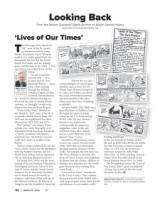
I’ve run across this
cartoon strip — or to
be more precise, brief
illustrated history — many
times while cruising
through the William
Davidson Digital Archive
of Jewish Detroit History.
At a recent JN editorial meeting, we
discussed the state of current Jewish
cartoons, so I thought I would write
about a very fine one from the past.
“Lives of Our Times” debuted in
the March 21, 1947, issue of the JN. It
remained a weekly feature from 1947-
1949 and was republished five times
afterward in 1953, 1970 and 1973.
This “cartoon” was unique. Every
episode was a mini-biography of an
important Jewish American, European
or Israeli, sometimes well-known,
sometimes not. All of them, however,
made their mark on modern world
history.
Various writers produced the text for
“Lives of Our Times,” but the illustrators
were the brothers Norman and Sol
Nodel. Each of them had an important
role in American illustration history.
Sol Nodel (1912-1976) was the more
famous of the two brothers. Educated at
Washington University School of Fine
Arts, St. Louis, and the Grand Central
School of Art in New York, his works
can be found around the world. In
America, collections of his work are in
the National Archives, the Library of
Congress and the Franklin D. Roosevelt
Library. He was also
a famed designer of stained-glass
windows such as those for the
Mount Sinai Memorial Chapel in
St. Louis. For hobbies, he played
the violin, refurnished furniture
and decorated his wife’s cakes
(those must have been something
to behold!).
Norman Nodel (1922-2000) was a
great illustrator of children’s books.
He began his career as a map
maker for the U.S. Army during
WWII. After the war, Norman
became a successful artist,
creating works for numerous
magazines, comic books and
children’s books. Most notably,
he was a chief illustrator of the
famous Classic Comics.
Created by Albert Kanter, Classic
Comics was a series of comic books
(1941-1969) that were illustrated,
abridged versions of classic literary
works. For example, the first issue was
The Three Musketeers. In total, 169
issues of Classic Comics were published,
all drawn from the classics. Millions of
children were introduced to the world’s
great literature when reading these
comic books.
“Lives of Our Times” reminds me
of the Classic Comics. They combine
the great artwork of the Nodels with a
wide range of great stories about Jewish
contributions to our modern world.
Reading weekly epi-
sodes, one learned the history of peo-
ple such as Rabbi Meir Berlin, for whom
Bar-Ilan University in Israel is named
(Sept. 14, 1973, JN). Or the famous
American Zionist Dr. Abba Hillel
Silver (Oct. 15, 1954) and Brig. General
Yaakov Dori, first chief of staff of the
Israeli Defense Forces (Dec. 24, 1948).
The JN published nearly 100 “Lives of
Our Times.” This is good reading and
viewing. Just search by the title in the
Davidson Archive.
Want to learn more? Go to the DJN Foundation
archives, available for free at www.djnfoundation.
org.
Mike Smith
Alene and
Graham Landau
Archivist Chair