

MARCH 9 • 2023 | 13
continued on page 14
hundreds of cases, that people who have
few resources and who are scared after
being arrested will confess if enough
pressure is put on them, even if they are
innocent.
As an example, he cited Harris County,
Texas, which includes Houston, where
45 defendants were exonerated months
or years after their convictions on drug
charges when lab tests showed nothing
illegal in the materials seized from them.
Most probably couldn’t make bail after
they were arrested and agreed to a “take
it or leave it” offer promising lighter sen-
tences if they confessed, Gross said.
Finding cases of wrongful conviction
isn’t always easy, he said. Our legal system
is fractured, with different rules and pro-
cedures in every state. Most cases are tried
at the county level, and few states keep
centralized records.
Most of the documented exonerations
are in homicide cases, which attract more
interest because the consequences are so
severe: often lengthy prison terms, includ-
ing life, or the death penalty. Cases involv-
ing sexual assault, child abuse and drugs
are also common.
Thanks to DNA evidence, the num-
ber of wrongful convictions for rape has
declined significantly. If cases even go to
trial, DNA evidence usually overrides eye-
witness accounts, Gross said.
In a country with millions of criminal
convictions every year and more than 2
million people in prison, a wrongful con-
viction rate of even 1 percent amounts to
tens of thousands of errors, he said.
The registry also highlights disparities
in sentencing. African Americans, for
example, make up 13.6% of the U.S. popu-
lation but accounted for 53% of the 3,200
wrongful convictions in the registry’s
latest report. That disparity holds across
all crime categories except white-collar
crime, Gross said.
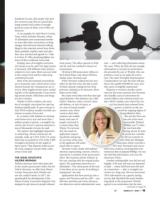
THE LEGAL ADVOCATE:
VALERIE NEWMAN
Defense attorneys don’t often take jobs
in the country prosecutor’s office, but for
Valerie Newman, an offer from Wayne
County Prosecutor Kym Worthy was
one she couldn’t refuse. In 2017, she
spearheaded the development of the
Wayne County Conviction Integrity Unit,
designed to get innocent people released
from prison. The office opened in 2018,
and its work has resulted in dozens of
exonerations.
Of about 2,500 prosecutors’ offices in
the United States, only about 100 have
similar units, Newman said.
When Newman walked into her new
office for the first time, she had a stack
of letters already waiting for her from
prisoners claiming to be innocent. More
letters arrive daily.
She reads every letter, but they don’t get
equal attention. She dismisses any “affir-
mative” defenses, where convicts claim
self-defense, or lack of intent, or
(in cases of sexual assault)
consent; cases where
convicts claim their
sentence was unduly
harsh; and cases of
people convicted in
a county other than
Wayne. To everyone
else, she sends an
application request-
ing details and giving
an overview of her unit,
so the applicant will under-
stand what to expect.
Newman works closely with defense
attorneys representing convicts, which is
unusual for a member of the prosecutor’s
office. She examines all the evidence in
the case, starting with the original police
report. She sometimes interviews co-
defendants. “The whole point of the unit
is that there are no secrets. Everything is
transparent,” she said.
Applications that have merit go into a
queue, and Newman and her staff — one
full-time and three part-time attorneys,
two detectives and an administrative assis-
tant — start collecting information about
the cases. When she feels she has enough
information to warrant an exoneration,
she presents the case to Worthy, who can
petition a court to set aside the convic-
tion. The state’s Wrongful Imprisonment
Compensation Act says the state will pay
those who qualify $50,000 for every year
they spent wrongfully imprisoned.
Requests to overturn murder convic-
tions are the most common, but Newman
also handles cases of convictions for
armed robbery and criminal sexual con-
duct. She’ll consider cases where the con-
vict has already been released from
prison, so that he or she can
avoid the ongoing stigma of
being labeled a felon.
She says her first case
was one of her most
memorable. Richard
Phillips was 71 when
he was freed after
having served 45 years
in prison for a murder
he did not commit. In
early 2018, the Michigan
Innocence Clinic won him a
new trial. Newman’s unit uncov-
ered some evidence involving false trial
testimony that exculpated Phillips. No one
else had that information, not even the
Innocence Clinic.
Another unforgettable case did not end
happily. A 60-year-old man was deported
to Italy — where he’d been born but had
no connections — after a wrongful con-
viction in a drug case. His son uncovered
DNA information via a genetic testing
service that identified the man’s brother,
long dead, as the perpetrator. Worthy
agreed to an exoneration, but the man
Valerie
Newman