

26 | MARCH 2 • 2023
B
ack in October,
walking on the
Edmund Pettus
Bridge, Temple Israel mem-
ber Simona Seiderman felt
the history under her feet
and all around her.
“The significance of it,
walking across freely, here
and now, and how much
people were willing to get
beaten on this bridge, just for
the right to vote,” she said.
“There’s so much power in
that, you can feel and can’t
help reflecting on how peo-
ple fought for their rights.
It’s emotional just thinking
about it.”
The Edmund Pettus Bridge
became a flashpoint in the
Civil Rights Movement.
Peaceful protesters attempt-
ed to march from Selma to
Montgomery to demand
voting rights for African
Americans, and they were
met on the bridge with vio-
lence in an event that became
known as Bloody Sunday on
March 7, 1965.
It was a turning point that
helped turn the public tide
and eventually helped in the
passing of the Voting Rights
Act of 1965.
The bridge is now a
symbol of the Civil Rights
Movement and is an import-
ant reminder of the courage
taken to stand up for what
was right.
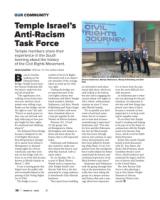
Visiting the bridge was
an important part of the
civil rights journey that
Seiderman and fellow Temple
Israel members, Marilyn
Nathanson, Gail Katz, Wendy
Kohlenberg and Susan Singer
took in October with more
than a hundred others in
a trip put together by the
Women of Reform Judaism.
Between Oct. 19 and
23, the group visit-
ed Montgomery, Selma,
Birmingham and Atlanta to
listen and learn about the
history that is still important
today.
Seiderman and Nathanson
also wanted to make sure
they shared the history, and
what they learned, with so
many others.
So, on Tuesday, Feb. 21,
as part of Black History
Month and in conjunction
with Temple Israel’s Anti-
Racism Task Force, the duo
presented to a large audience
at Sisterhood’s Chai Mitzvah
luncheon.
They spent hours building
an informative and educa-
tional slide show, which not
only looked at the history,
but also led to engaging dis-
cussion about civil rights in
2023, which, unfortunately,
remains an issue 57 years
after Bloody Sunday.
“It’s so painful, you don’t
want to look back some-
times; but it’s so import-
ant to look back because
remembering is important,”
Seiderman said. “Not only
for Jews and the Holocaust,
but also for Black people
who have been through
slavery and continue to expe-
rience discrimination and
have been killed for breath-
ing while Black. It was very
painful from that standpoint,
but it really helped me better
understand the history and
continued experience of my
Black brothers and sisters.”
Seiderman and Nathanson
took the group through their
trip in the presentation, but
really they were taking the
group on a deeper journey
and history that sent a mes-
sage about how important
it is to learn from the past,
even the most difficult, hor-
rible moments.
As Seiderman put it when
she was planning for the pre-
sentation, it’s important to
ask why and how things hap-
pened, even when it hurts,
because it reminds us how
important it is to keep work-
ing for equality today.
It’s an effort that Temple
Israel is working and hoping
to be part of in the future in
conjunction with the Temple
Israel Anti-Racism Task
Force, which is led by Rabbi
Marla Hornsten.
Earlier this month Temple
hosted a book discussion
with Dr. Tara Hayes, the
Book Club Professor, about
Geraldine Brooks’ novel
Horse, which looked at and
examined the legacy and his-
tory of slavery and freedom
in the United States.
The Anti-Racism Task
Force is also planning a
trip to the Charles Wright
Museum of African
American History this
month.
Temple Israel’s
Anti-Racism
Task Force
OUR COMMUNITY
SEAN SHAPIRO SPECIAL TO THE JEWISH NEWS
Temple members share their
experience in the South
learning about the history
of the Civil Rights Movement.
Simona Seiderman, Marilyn Nathanson, Wendy Kohlenberg and Gail
Katz