

MARCH 2 • 2023 | 19
significant impact.”
This dedicated startup
group of students met every
week, starting in the fall, to
design educational materials
and logistics for the event.
“My favorite part was
the teamwork that made it
happen. It wouldn’t have
been possible with just one
person!” said sixth-grader
Maya Weingarden, who
created an educational video
for the whole school with
fellow sixth-grader Ally
Berman.
“It was difficult getting
everyone ready for the
composting day. We had
to learn what could be
composted. I was surprised
to learn that dairy and meat
can be composted in certain
places,” said Audrey North, a
fourth-grader on the Green
Club.
The Green Club students
hope that their efforts
won’t end at Compost Day.
The aim of the club is to
empower students to make
a positive impact within
their community and also
to inspire other kids in their
school. The group will pursue
a new project after Compost
Day is completed, as part of a
larger effort to give students
more chances to take
environmental action.
Students are acutely aware
of the climate crisis. A 2021
survey of more than 10,000
Gen-Zers and Millennials
across 10 countries asked
respondents about their
thoughts and feelings related
to the climate crisis. More
than 50% reported feeling
climate anxiety, grief and
powerlessness, and more than
45% stated that these feelings
negatively impacted their
daily life.
When the call went out for
students to join a volunteer,
environment-focused group,
the students at Hillel Day
School showed up with
concerns about climate
change, but they also had
ideas on how to improve
their school’s environmental
footprint.
“I was already thinking
about ways to help the Earth,
because we only have one
Earth,” said fourth-grader
Asher Meisner. “When I
heard about the Green Club,
I knew I had to join,” he
added.
Students are increasingly
passionate about the
environment and the climate
crisis. Hazon’s Amit Weitzer
says, “To build toward
meaningful change, it is
critical to support passionate
individuals [students and
teachers] with strong
structures and systems,
so that the work doesn’t
rely on a particular group
of individuals but can be
sustained and can grow over
many years as a part of the
identity of the school.”
Laura Pasek is the faculty adviser for
the Green Club at Hillel Day School.
continued on page XX
Are You Looking to Make
a Change at Your School?
Hazon Detroit has these top four recommendations
for schools looking to make positive impact on the
environment:
• Create opportunities for youth leadership and for
student-voice and priorities to impact school policies
and programs.
• It is OK to start small — take stock of where you
have influence and power — and make changes there!
• Designate at least one (ideally two) dedicated green
staff leader(s) with a formal responsibility to steward
this programming (rather than this being a responsibility
on top of an already full plate of responsibilities).
• Examine your existing operations and programs
and make changes that lessen your impact on the
environment. Integrate sustainability values into choices
about school lunches, waste systems, leadership
development programs, field trips and supplemental
learning opportunities, capital improvement plans and
landscaping.
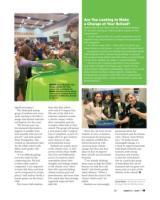
ABOVE: Second-grader Lilly
Kessler dumps her food
scraps into a compost bin.
RIGHT: Members of the Green
Club collect compost from the
preschool at Hillel Day School
on Feb. 6.