

FEBRUARY 23 • 2023 | 47
unit allows you to do is offer
truly personalized radiation
treatment by recontouring the
key areas of concern while the
patient is on the table and opti-
mizing the radiation plan on
the fly.”
REAL-WORLD SUCCESSES
Dr. Parag Parikh, leader of the
MRI-guided radiation program
at Henry Ford, specializes in
gastrointestinal cancers, includ-
ing pancreatic cancer, which
is particularly challenging to
treat.
“Not only are they difficult
cancers, but they also tend to
move a lot because as you’re
breathing, organs in the abdo-
men are moving all the time
along with the diaphragm,”
Parikh explained.
Parikh has been using the
adaptive radiation with his
pancreatic cancer patients and
just presented an international
study that he led which showed
he was able to treat pancreatic
cancers in only five precision
treatments of Stereotactic
MRI-guided Adaptive RT (or
SMART).
“Not the traditional five
weeks, but five days,” Parikh
said. “Because of the millimeter
accuracy and real-time adap-
tive planning, patients showed
no serious adverse events,
which was the goal of the clin-
ical trial. There was also an
early signal that survival rates
looked promising.”
This was the largest study in
the world of ablative (stereo-
tactic) radiation for pancreatic
cancer.
In another study of pros-
tate cancer patients who were
randomly assigned CAT-scan
based treatment (a standard
of care across the globe) or
MRI-guided focused radiation,
it was shown that patients
experienced significantly fewer
side effects and better qual-
ity of life by using the MRI-
guided approach. Dr. Aharon
Feldman, senior staff radiation
oncologist at HFH-Cancer,
together with the team, offers
this latest treatment option
for patients, which can also be
completed in only five treat-
ment sessions.
“There are more and more
exciting data emerging that
show us this MRI-guided
radiation treatment truly helps
patients,” Movsas said.
ISRAELI DOCTORS REACT
Movsas said the Israeli doctors
spent quite a bit of time talking
to the experts at HFH. “They
were also able to see our work-
flow and were amazed to see
the teamwork and coordination
it takes to ensure the patients
were getting the very best treat-
ment.”
Henry Ford Health is also a
leader in another related novel
technology called CT-Guided
Adaptive radiation, which also
improves imaging that allows
doctors to adapt in real time.
“We are proud to be one of
the only cancer centers in the
world with both MRI-guided
and CT-guided adaptive radia-
tion programs,” Movsas said.
“We were impressed by the
team’s dedication and knowl-
edge, as well as their use of
advanced MRI-based radiation
for patient benefit,” said Dr.
Yaacov Lawrence, interim chair
of radiation oncology at Sheba
Medical Center. “Patients in
Michigan and beyond are ben-
efiting from this cutting-edge
department.
“We hope to acquire an MRI
LINAC in the coming year,” he
added.
While at HFH, Lawrence
presented and discussed
Sheba’s work on novel radiation
techniques to overcome pain in
pancreatic cancer.
“We look forward to deep-
ening relations with the HFH
team regarding both training
and future research togeth-
er,” Lawrence said. “Our
dream would be to create a
common Sheba-Henry Ford
Health research program that
would further collaboration
between our institutions for
patient benefit on both sides of
the Atlantic.”
Dr. Aaron Allen, execu-
tive vice chair of Radiation
Oncology at Shaare Zedek
Cancer Center, trained at the
University of Michigan in
Radiation Oncology and said
it’s great to see how Henry Ford
has not only become a leader
in cancer care but also how Dr.
Movsas has taken Henry Ford
Health-Cancer to the next level
in becoming an international
center for research and train-
ing.
“The entire team at Henry
Ford were very warm and
generous with their time. It
was worth every minute of
the long trip from Israel to see
the excellence and innovation
going on at Henry Ford Health.
“We look forward to con-
tinuing the Israeli-Henry Ford
Health partnership in the
future,” Allen added.
“We do too!” exclaimed
Movsas, who feels very hon-
ored that these teams from
Israel all came to Henry Ford
Health to see the exciting MRI-
guided radiation program in
action.
Benjamin Movsas lives in
Southfield with his wife, Dr.
Tammy Movsas. They have
four married daughters, all
involved in health care, and six
grandchildren.
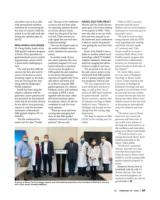
A group of Henry Ford oncology experts and international physicians who traveled to Detroit to see and
learn more about ViewRay MRIdian.