

JANUARY 5 • 2023 | 25
are very camera shy and that’s ingrained in
me, too.
Despite my reluctance, I did believe that
it’s important to reach a wider audience
with the story of the Chasidic community.
The New York Satmar community seems
to be one of the most understudied subcul-
tures, and most of the pop culture represen-
tations are dark and misleading, creating
this narrative of an “other.
” So, I think it’s
important to get beyond that. It’s incredible
that such a unique, misunderstood world
shouldn’t get more sensitive, nuanced cov-
erage. So, in the past year, I relented and
began been publishing various videos on a
YouTube channel.
What has been the reception to your
YouTube channel among Satmar residents of
Williamsburg?
FV: It’s been very surprisingly positive. A
lot of people stop me while I’m on my tours
and thank me for my videos. To my sur-
prise, many people have seemingly appreci-
ated this kind of coverage. They have been
incredibly supportive.
Tell me about your experience getting local
Williamsburg residents to appear in videos.
FV: It’s very hard to get people to agree to
be on my channel. Many people will stop
me on the street and talk to me, but when
they realize that my cameraman is with me
and he’s rolling, they’ll beg me not to pub-
lish the footage. It’s an interesting contrast
with the non-Chasidic kids from the neigh-
borhood who, when they see a camera, will
often come up to us and ask us if they can
appear in our show. Chasidim are incredi-
bly camera shy, in part, I think, because it’s
a very closed and small world and anyone
who stands out can end up feeling ostra-
cized.
Pearl, who showed us her home in an
episode of my YouTube series, “Inside a
Hasidic Home,
” was different. She is a fero-
cious lady who manages to at once have so
much respect in the community while also
agreeing wholeheartedly to be on film. I
think a part of why Pearl was comfortable
being on film was because she is older, and
she has no kids in the school system or
shidduch (marriage) system. Pearl was eager
to help me from my very first phone call
to her. My video with her ended up getting
100,000 views in a month, which absolutely
shocked us.
I’ve also managed to get some other peo-
ple to agree, and the process often involves
showing people the edited version before
it goes live on YouTube to make sure they
are comfortable with it. I will never publish
something that is disrespectful, and I think
people trust me.
What have you learned since taking your
“inside baseball” perspective to YouTube?
FV: I’ve learned that my most eager
audience are Chasidim themselves! While
I think of my target audience as outsiders,
Chasidim have a great interest in their own
world, in seeing the representation and
sharing insights in the comments. We all
want to understand the society that we are
in and, for Chasidim, there’s a great dearth
of anthropology. I am guessing in the future
there will be a growing self-awareness as
more people start to study the culture from
a bird’s-eye view.
What do you hope to accomplish with your
YouTube channel?
FV: I hope to help build a non-judg-
mental curiosity into Chasidic culture. I’m
hoping to inspire others to share different
parts of this world and to inspire others to
go beyond black and white. I hope that the
world’s understanding of this community
will be much more nuanced, and I think I
can contribute to that end through my own
work.
What are some types of videos you plan
to make for your YouTube channel in the
future?
FV: I hope to do more “In the Streets”
videos. I am also going to film a video on
the Yiddish language. I would love to cap-
ture the vibrancy of the culture in videos,
so special occasions are my go-to. I dream
of getting a Chasidic woman to show me
her wardrobe. I also like to do food videos,
and I look forward to sharing the Chasidic
Shabbos meal and other special Chasidic
foods.
What do you hope to accomplish as more
Chasidim watch your YouTube videos?
FV: I think at this time, so many locals
watch my YouTube channel that I have lost
all my coveted anonymity. I miss it! On the
other hand, I get a lot of fascinating infor-
mation through their engagement with my
work, and I’m honored that people take me
seriously. But, ultimately, I think my videos
are giving locals a bit of a vocabulary with
which to talk about their own world to out-
siders, which I think is important.
Rabbi Jason Miller is a local educator and entrepre-
neur. He is the president of Access Technology in West
Bloomfield.
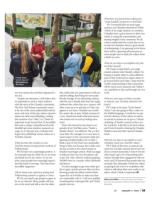
Frieda Vizel
on her tour of
Williamsburg,
Brooklyn