

8 | DECEMBER 22 • 2022
PURELY COMMENTARY
continued from page 9
column
Celebrating Chanukah with Luba
I
met Luba recently at a
Chanukah party in Israel
organized by Ten Gentiles,
an Israeli nonprofit run by
my friend Shirley, a Chinese-
American Christian, which
works to build bridges among
Christians and Jews.
About three dozen sur-
vivors participated in the
celebratory event replete
with inspiring words, music,
“Torah yoga,” sufganiyot
(traditional Chanukah jelly
donuts) and gifts for all.
The donations came from
Christians all over the world.
I have had the privilege of
partnering with Ten Gentiles
on a variety of projects on
behalf of my U.S. nonprofit,
the Genesis 123 Foundation,
including providing for some
basic needs of Holocaust sur-
vivors who live on the edge of
poverty.
The event was delight-
ful, seeing the survivors so
engaged and loved made
me happy. The “Torah yoga”
helped emanate light from
their bodies as if they were
candles. The music was fes-
tive, seasonal and participa-
tory. Two elderly survivors
shared their stories of coming
out of the darkness of the
Holocaust into the light of
Israel. Decades later, the men,
remembered the war and
their suffering vividly.
It was significant that other
survivors wanted to share
as well, to tell their stories.
Being able to do so, as Jews
free in the Jewish homeland,
was affirming and liberating.
Others listened intently and
asked questions. Even for
those who knew one another,
among the 650 remaining sur-
vivors in their town of 40,000
people, it was an important
support group.
One man, Vladimir, shared
his wartime experiences. I
learned later that he lost his
wife and a daughter, and the
only other relative lives in
Florida. Basically, he’s alone.
Making matters worse, among
survivors from the former
Soviet Union, most have no
pensions as they came to
Israel after their working lives
had ended. So the extra needs
of these survivors are great.
It’s an honor to help.
I met Shalom, who was
born Carlos in Spain. He
sought me out to tell me how
moved he was. He remembers
from his youth in Spain the
persecution by the Catholic
church. Choking back tears,
he told me how meaning-
ful it was to see me, an
Orthodox Jew, working with
Christians who love Israel
and the Jewish people. Until
then, his experiences with
Christians had only been of
persecution and hate. He had
never experienced anything
like it, redeeming in a way
with Christians showing true
love for Israel and the Jewish
people.
One Russian-speaking
woman was waiting until the
end to get a pair of slippers
that were among the presents.
I asked her in Hebrew what
her shoe size is. She didn’t
understand, so I grabbed
one of the other survivors to
translate. It reminded me of
my visits to the Soviet Union
in the 1980s where conver-
sations often went between
Russian, Hebrew and English.
Once, Yiddish was added to
the mix.
As the other elderly woman
from Moscow translated, I
learned that the woman I was
talking to had just arrived
from Ukraine a few months
earlier. She introduced me to
her son. That’s when things
clicked.
Some months ago, I
was told about an elderly
Holocaust survivor who had
just arrived from war-torn
Ukraine with her 56-year-old
disabled son. They fled their
home in Kharkiv and made
a new home in Israel. Their
apartment was furnished with
the bare minimum, including
furniture that was not quite
as old as she was, but not
by much. The bed that the
woman had been sleeping in
was falling apart, so much so
that she was afraid to sleep
in it.
I was asked if we, the
Genesis 123 Foundation,
could help. Could we buy her
a new bed? “Yes.” I called the
owner of a store in Jerusalem
and explained the need. He
told me he’d get her the most
comfortable bed she’s ever
slept in. I ordered and paid
for it. Within a week the bed
was delivered.
Luba was the one to receive
the bed. Once we figured out
the connection, she was so
grateful. I asked her how her
bed was, and her face lit up,
rattling off her praise and
gratitude in Russian.
I certainly didn’t go to the
party to meet Luba, but it was
a huge blessing for us both.
There’s a principle in Judaism
that the highest form of giv-
ing tzedakah (charity) is to do
so anonymously. I was mind-
ful of that as I spoke to Luba,
careful not to embarrass her.
She wasn’t embarrassed at all,
just truly happy to meet me
and grateful.
I had imagined Luba as a
broken elderly woman, living
in hard times. Indeed, the
original picture I saw of her
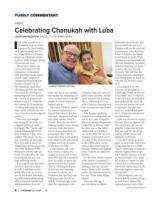
Jonathan Feldstein and Luba
JONATHAN FELDSTEIN SPECIAL TO THE JEWISH NEWS