

DECEMBER 15 • 2022 | 53
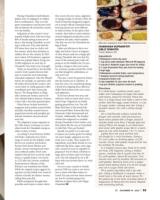
During Chanukah, Israeli bakeries
display trays of sufganiyot in endless
flavor combinations. They are truly
pastry masterpieces and become avail-
able in bakeries all around the country
over the holiday.
Sufganiyot are the country’s most
popular holiday food, with more than
80% of Israelis eating at least one of
them a day during Chanukah, accord-
ing to Aish.com. They state that the
IDF alone buys close to a half a mil-
lion donuts, which they distribute to
soldiers all over the country. In 2021,
news station i24 broadcast a segment
about one popular bakery frying over
25,000 sufganiyot on each day of
Chanukah. Now that’s a lot of dough!
Today, an annual fierce, but friendly,
creative rivalry sparks between bak-
eries to create the most interesting
Chanukah sufganiyot. Take the Roladin
bakery for example, an operation with
94 outlets all around the country, who
carries them in vanilla ganache, toffee
crumbleand and violet cheesecake
flavors. The Shang bakery in Haifa
sells a lemon pie version, and in Tel
Aviv, Metuka bakery features a banana
cream with a chocolate ganache glaze.
Other flavors include strawberry
margarita, halva praline, peanut butter
and jelly, chocolate caramel smores,
peppermint mocha and pumpkin pie
streusel. Somehow, this just doesn’t
seem fair.
The sufganiyot recipe originates in
the 14th century in Europe, at a time
where foods for Chanukah emerge as
either as dairy or fried.
According to food historian Rabbi
Gil Marks, Sephardic Jews fried a
range of sweets for the holiday, while
the Jews in northern and Eastern
Europe fried cheese blintzes and
donuts. Award-winning food writer
and cookbook author Davit Leite
explains that the first record of a jelly
donut, or gefullte krapen, was found
in 1532 after the German cookbook
Kuchenmeisterei (Mastery of the
Kitchen) was translated into Polish.
While the original recipe suggests fry-
ing them in lard, Polish Jews switch to
chicken schmaltz for dietary reasons,
calling them ponchik.
Polish immigrants brought their
ponchiks and recipes to Israel, where
they receive the new name, sufganiyot,
or spongy dough. In the late 1920s, the
Israeli Federation designated sufgani-
yot as Israel’s official Chanukah food,
knowing donuts are more difficult
to make at home. In the spirit of job
creation, they built an entire industry
around sufganiyot production, trans-
portation and sales, which explains
why they are now the Chanukah dar-
ling of Israel.
Latkes are delicious in their own
right, and before I knew of sufganiy-
ot, they always made me a happy girl
during Chanukah. But now that I’m
aware of the annual pastry bake-off
going on in the Middle East, I’m pro-
posing a change to this year’s menu.
For centuries, people around the world
use fried dough for celebrations, so
why aren’t we?
This year, I want the gourmet donuts
that the Israelis use to celebrate. At
least this once, I’m considering taking
a break from dipping those delicious
skillet-fried potatoes into sour cream
and applesauce.
If you have donut envy now, and
without a ticket to Israel, don’t worry,
there’s hope. Sufganiyot are finally
gaining ground here, too. You will
likely find them in the Jewish bak-
eries around Metro Detroit like Star,
Diamond, Golds International and
Zeman’s. Additionally, The Dunkin’
website lists sufganiyot as available
during Chanukah at their kosher-certi-
fied outlets, like the one on Greenfield
in Oak Park. Wow, go Dunkin’!
Should you prefer to fry and want
to bypass your potato grater for rolling
out some dough, sufganiyot are rela-
tively easy to make. They require few
ingredients, most likely already in your
cupboard, like flour, sugar, yeast, eggs
and a neutral oil such as vegetable or
grapeseed. You fry them, roll them in
sugar, then set them aside to let them
cool. The only thing left to do is fill
them with your favorite flavor. So, what
will it be?
Are you a jam, custard or Nutella
person? Will you create a new inven-
tion to share with fellow bakers in
Israel? You may not have these answers
yet, but it’s certainly going to be
delicious to figure them out! Happy
Chanukah!
(Recipe adapted from Marthastewart.com)
CHANUKAH SUFGANIYOT
(JELLY DONUTS)
Yield: Makes 20
Ingredients
2 tablespoons active dry yeast
½ cup warm water (between 100 and 110 degrees)
¼ cup plus 1 teaspoon sugar, plus more for rolling
2 ½ cups all-purpose flour, plus more for dusting
2 large eggs
2 tablespoons unsalted butter, room temperature
½ teaspoon ground nutmeg (optional)
2 teaspoons kosher salt
3 cups vegetable oil, plus more for bowl
1 cup jam, Nutella, prepared custard or pudding
Directions
In a small bowl, combine yeast, warm
water and 1 teaspoon of sugar. Set aside
until foamy, about 10 minutes. Place the
flour in a large bowl and make a well in the
center. Add the eggs, yeast mixture, ¼ cup
of sugar, butter, nutmeg and salt. Using a
wooden spoon, stir until a sticky dough
forms.
On a well-floured surface, knead the
dough until smooth, soft and bounces
back when poked with a finger, about 8
minutes (add more flour if dough gets too
sticky.) Place the dough in an oiled bowl
and cover with plastic wrap. Set in a warm
place to rise until doubled, 1 to 1 ½ hours.
Lightly flour the work surface and
roll dough to ¼ inch thickness. Using a
2½ inch cutter or drinking glass, cut 20
rounds. Cover with plastic wrap and let rise
for another 15 minutes.
In a medium sauce pan, heat oil to medi-
um heat, 370 degrees. Using a slotted
spoon, carefully slip 4 rounds into the oil.
Fry until golden, about 40 seconds. Turn
donuts over and fry another 40 seconds or
until golden. Remove from oil to a paper
towel lined baking sheet. Fry all the dough
and roll in sugar while still warm.
Fill a pastry bag fitted with a tip with
jam. Using a toothpick or skewer, make a
small hole in the side of each donut. Fit
the pastry tip in the hole, and pipe about 2
teaspoons of filling into the donut. Repeat
with remaining donuts.