

8 | DECEMBER 8 • 2022
essay
Bringing Chanukah into Our Homes
T
he mail arrives just as
my kids get home from
school, and they’ve
already eyed the magazine
they’ve been waiting for: The
Amazon Gift Guide. Each child
runs to the crafts drawer to
find their own
color marker,
armed and ready
to circle every
item they want
for Chanukah.
Within 45 min-
utes, the maga-
zine is returned to
me, edited and primed for me to
buy (at least) one of everything.
Happy Chanukah, Amazon.
Enjoy my paycheck.
Chanukah is such a special
holiday. The energy, the excite-
ment, the magic, the stories —
it’s something everyone looks
forward to, and not only because
of the presents. With a little
intentionality, we can transform
Chanukah from a holiday of
receiving gifts to a holiday we
learn to receive as a gift itself.
How, you ask?
It all starts with the latkes.
Yes, those perfectly delicious
fried potato pancakes that
fill our tables and our bellies
during the holiday season. This
tasty tradition presents us with
the opportunity for a teach-
able moment for all who have
gathered around our table. As
we savor each oily bite, we are
reminded of the Holy Temple,
defiled by the Greeks, and the
lone pitcher of pure oil that
remained untouched. That little
container of oil should have lit
the menorah for just one day,
yet miraculously the menorah
remained lit for eight days!
As our hungry guests go back
for seconds, we can frame the
experience for them: just as the
miracle of the oil gave hope to
Jewish people, so, too, the possi-
bility for miracles today should
inspire hope in all of us. So,
whether it’s your great-grand-
mother’s recipe or the frozen
ones from Trader Joe’s that are
better than we care to admit,
bring out those latkes, spin your
dreidels, and let the oil spark
hope and frame our miraculous
shared narrative.
The latkes, though, are not
enough.
Without getting entangled
in a Daylight Savings Time
discussion, Chanukah always
falls when the days are shortest,
and the darkness is all-encom-
passing. In fact, the month
Kislev, in which Chanukah falls,
can be understood as “Kis Lo,
”
“hidden to him,
” implying that
this is a month where things
are hidden, due in large part, to
the darkness. Yet, it’s at this very
moment of seasonal darkness
that we are given Chanukah, the
holiday defined by light.
We begin Chanukah with one
little candle, placed in our win-
dow for all to see, and proceed
to add an additional flame each
night. We watch as day after day,
our small light increases until
our menorahs reach capacity,
with eight beautiful flames flick-
ering in our window.
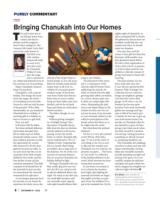
The placement of the meno-
rah is a critical piece of the
mitzvah called Pirsumai Nisah,
publicizing the miracle, for
while we benefit from the light
growing daily within our homes,
we, as Jews, always make sure
to share our unique light with
others, illuminating the dark-
ness as our flames flicker in the
window for all to see. For it is
not just because of my menorah
or your menorah, rather it is the
collective participation of the
Jewish nation that allows us to
be a light unto the world.
But what about the spiritual
darkness?
We live in a very self-centered
world: iPhone, iPad, iMes-
sage. “I” am is at the center of
everything we do. It is so easy
to slip into this mindset over
Chanukah, too: my wish list, my
presents, my party … This focus
on “my needs” is a reflection
of the spiritual darkness in the
world, which prevents me from
seeing those around me.
In our home, we wanted to
try to reframe the narrative.
Each night, after lighting the
menorah and before we began
that night’s activities, we gave
each of our five children $1 to
put in the tzedakah box. By the
eighth night of Chanukah, we
had accumulated $40 in charity.
We gathered to discuss how our
tzedakah would help the com-
munity and where we should
make our donation.
One year, they used the
money to buy gifts for those less
fortunate, while another year,
they decided to hand-deliver
the $40 to their organization of
choice, their school. As parents,
we tried to plant seeds for our
children so that the concept of
giving went hand-in-hand with
receiving.
This past summer, we saw
those seeds take root. Our
6-year-old son opened his first
business, Solly’s Garbage Can
Collection Service, where he
brings our neighbors’ garbage
cans from the curb to their
garage. At 50 cents a can, his
business has become quite
lucrative! Each week, he proudly
gathers his earnings and sepa-
rates a 10th of his total to give
to charity. It’s not easy to give up
your hard-earned money, but
just like on Chanukah when he
saw himself as a giver, for him,
giving is just what you do when
you find yourself in a position
of receiving. Getting presents is
something we all look forward
to, and giving should be, too.
This Chanukah, let’s challenge
ourselves to infuse each day with
deeper intentionality, turning
latkes into teachable moments,
proudly spreading our light and
striving to be givers. If we suc-
cessfully navigate the darkness
and ignite the spark within our-
selves, imagine how brightly our
collective light will shine.
Erin Stiebel, senior educator for
Partners Detroit and the director of
NCSY GIVE, and her husband, David,
live in Southfield and are the proud par-
ents of the greatest kids in the world.
PURELY COMMENTARY
Erin Stiebel