

58 | OCTOBER 13 • 2022
SPIRIT
A WORD OF TORAH
O
f all the festivals,
Sukkot is surely
the one that speaks
most powerfully to our time.
Kohelet could almost have
been written in the 21st
century. Here is the picture
of ultimate
success, the
man who has
it all — the
houses, the cars,
the clothes,
the adoring
women, the
envy of others
— he has pursued everything
this world can offer from
pleasure to possessions to
power to wisdom and yet,
surveying the totality of his
life, he can only say, in effect,
“Meaningless, meaningless,
everything is meaningless.”
Kohelet’s failure to find
meaning is directly related
to his obsession with the “I”
and the “Me”: “I built for
myself. I gathered for myself.
I acquired for myself.”
The more he pursues his
desires, the emptier his life
becomes. There is no more
powerful critique of the
consumer society, whose
idol is the self, whose icon is
the “selfie” and whose moral
code is “Whatever works for
you.”
This is the society that
achieved unprecedented
affluence, giving people
more choices than they
have ever known, and
yet, at the same time,
saw an unprecedented
rise in alcohol and drug
abuse, eating disorders,
stress-related syndromes,
depression, attempted
suicide and actual suicide.
A society of tourists, not
pilgrims, is not one that will
yield the sense of a life worth
living. Of all things people
have chosen to worship, the
self is the least fulfilling. A
culture of narcissism quickly
gives way to loneliness and
despair.
Kohelet was also, of
course, a cosmopolitan: a
man at home everywhere
and therefore nowhere. This
is the man who had 700
wives and 300 concubines
but, in the end, could only
say, “More bitter than death
is the woman.”
It should be clear to
anyone who reads this in the
context of the life of King
Solomon, the author of the
book, that Kohelet is not
really talking about women
but about himself.
In the end, Kohelet finds
meaning in simple things.
“Sweet is the sleep of a
laboring man.” “Enjoy life
with the woman you love.”
“Eat, drink and enjoy the
sun.” That, ultimately, is
the meaning of Sukkot as
a whole. It is a festival of
simple things. It is, Jewishly,
the time we come closer to
nature than any other, sitting
in a hut with only leaves
for a roof, and taking in
our hands the unprocessed
fruits and foliage of the palm
branch, the citron, twigs of
myrtle and leaves of willow.
It is a time when we briefly
liberate ourselves from the
sophisticated pleasures of
the city and the processed
artifacts of a technological
age, where we take time
to recapture some of the
innocence we had when we
were young, when the world
still had the radiance of
wonder.
The power of Sukkot is
that it takes us back to the
most elemental roots of our
being. You don’t need to live
in a palace to be surrounded
by Clouds of Glory. You
don’t need to be gloriously
Rabbi Lord
Jonathan
Sacks
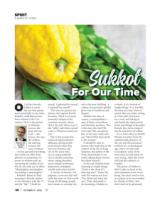
Sukkot
For Our Time