

52 | OCTOBER 13 • 2022
B
uck Showalter, manager
of the New York Mets,
went off on a weird tan-
gent during a press conference
in May. Instead of talking about
baseball, he informed the press
that he had changed the voice
that gives him driving instruc-
tions on Waze. He felt judged
by the English-accented voice
that he’
d been using because it
seemed smug, criticizing him
for his errors in driving. He felt
better about using the voice of
Cookie Monster, because “You
can’t get mad at the Cookie
Monster.
”
In the end, though, Showalter
chose the voice of Nathan
because it reminded him of his
son Nathan (according to the
Wall Street Journal, 6/27/22).
We know who the original
voice of Nathan belongs to.
Nathan Bigman moved from
the Detroit area to Israel in the
summer of 1998. Bigman, by
profession a technical writer,
has a hobby of songwriting.
So, it happened that he bought
some time at a recording studio
in Ra’anana about 15 years ago.
That was just about when a small
group of Israeli engineers and
entrepreneurs in Ra’anana were
turning their navigation software
into a start-up company they
called Waze.
“I didn’t know anything about
Waze. It meant nothing to me,
”
recalls Bigman, who had some
personal music projects and
found a local studio deal that was
in a small one-story house with a
citrus orchard behind it.
“It was very laid back,
” he said.
“The sound engineer was really
helpful. He had a lot of useful
suggestions. And one day they
said to me, ‘We have a library
of voices. Sometimes someone
comes in here and wants particu-
lar kinds of voice for something,
and maybe that can be you.
’”
They handed him a random
magazine and said, “Here read
this back; read this paragraph
into the microphone. We’ll
record it and put it in our
library.
”
After some time had passed,
Bigman got a call. “They said,
‘There’s a company called Waze
that needs to record an introduc-
tory video, the audio for a little
cartoon that will explain what
Waze is.
” That was Waze’s first
YouTube … a public introduc-
tion to the company.
Bigman read a script to explain
the Waze community — how
they track where you go, how the
traffic is going and whether the
police are there.
Waze grew since that first
YouTube animated video. Just a
few years later, in 2013, Google
bought Waze for nearly $1.3
billion.
As for the video, Bigman sadly
reports he cannot find it. “I’ve
looked for it.
” He calls it “his first
Waze opus.
”
Sometime later, the studio
was ready to record voices for
the mobile app, and they called
Bigman back to the studio.
He made a recording of traffic
directions in the presence of
a representative of Waze. “She
commented on every word I
pronounced . . . ‘Don’t say it this
way; say it that way.
’ I discovered
that — for someone from Detroit
or for someone whose parents
educated them weirdly — I said
“route” [rowt] . . . they wanted
me to say ‘root.
’ So, I took their
script and every place it said
‘route,
’ I crossed it out and wrote
‘root,
’ and I was set.
”
Bigman recorded voiced snip-
pets. “The sound engineer takes
the voice snippets and labels
them in a standardized way, adds
some effects,
” he said. “
And who
knows what they do to make the
voice a little bit more palatable
for the car environment. And
that’s it. I spent maybe an hour
reading those things into the
system.
”
Waze called him back a few
years later because there were
some snippets missing. Some of
them were functional and some
of them were things like “Drive
safe” and “
Are you ready? I am.
Let’s go!”
Being a voice of Waze has con-
sequences for Bigman. “People
in the neighborhood got very
excited to hear their neighbor’s
voice,
” he said.
Some people consider him an
authority because his voice gives
authoritative street directions.
They might ask him for accurate
information about the time of
afternoon services, for example.
Bigman’s brother-in-law had
his Waze set for Nathan’s voice.
“Once, I was riding with
my brother-in-law, driving to
Jerusalem, and he was using
Waze with my voice,
” Bigman
said. “I was in the backseat, with
my sister on the front seat. My
brother-in-law said, ‘I don’t think
Nathan knows what he is talking
about. Oh, wait he got it right!’”
On another occasion, “Once
I was driving with someone and
they were using Waze and it was
my voice. And I was unhappy
about the direction that Waze
was giving us . . . I said to them,
‘Don’t go that way; go this way.
’
“They said ‘But you know
Waze is telling us go the other
way.
’ So, I said, ‘Who are you
going to listen to, me or me?’”
When Bigman uses Waze, he
does not use his own voice. His
wife, former Detroiter Rachel
Karlin, thinks it would be
“creepy” for him to drive while
listening to his own voice.
What does “Nathan” have that
makes it an attractive voice for
Waze?
One of the people at Waze
told Bigman that “people like
my voice because it sounds like
someone just sitting in the seat
next to you telling you which
way to go. It kind of makes me
happy that I sound friendly.
”
The financial consequences
of having recorded a popular
voice for Waze are not extensive.
Bigman recalls that “the studio
paid me in free studio hours:
three or four hours of studio
time, worth maybe 150 shekel
per hour. Notice that I don’t get
any royalties.
”
Nathan Bigman and his wife
now live in Jerusalem.
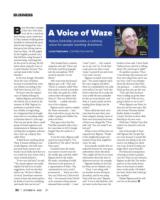
A Voice of Waze
Native Detroiter provides a calming
voice for people wanting directions.
LOUIS FINKELMAN CONTRIBUTING WRITER
BUSINESS
Nathan
Bigman