

OCTOBER 6 • 2022 | 49
F
or those who aren’t in
the know, it would be
easy to drive past The
Blue Bird Inn on Tireman on
Detroit’s west side without
giving it a second glance. The
building, with an old beer
and wine store on the left and
a towing shop on the right,
has boarded up windows and
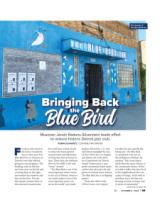
bars on the door. The sky-
blue façade contains hints of
the structure’s musical past,
but you’
d have to look closely
to notice the hand-painted
musical notes and silhouettes
of musicians that sit frozen in
time. These days, the rhythmic
flow of city traffic is the only
“music” around.
“The Blue Bird is one of the
most important music venues
in the city of Detroit, which in
our mind, makes it one of the
most important music ven-
ues in the world,
” says Jonah
Raduns-Silverstein, a 31-year-
old Detroit transplant by way
of New York City, Los Angeles
and Miami. He is the direc-
tor of operations for Detroit
Sound Conservancy, a non-
profit community-based music
archive that advocates for and
preserves Detroit music history.
The Blue Bird Inn is its flagship
project.
“From the 1940s to the
1970s, it was a very import-
ant place for jazz, specifically
bebop jazz. The Blue Bird
is considered to be one of
the birthplaces of bebop,
” he
explains. “But, more impor-
tantly than the music history, is
the community history. When
you talk to folks who have lived
in the neighborhood, this was
a place of magic. You’
d walk in
and there was a fire that was
burning in terms of music and
in terms of community.
”
Musician Jonah Raduns-Silverstein leads effort
to restore historic Detroit jazz club.
continued on page 50
ROBIN SCHWARTZ CONTRIBUTING WRITER
Bringing Back
Blue Bird
the
The facade of
The Blue Bird Inn