

56 | SEPTEMBER 29 • 2022
T
he 18th performance
of the Emerson
String Quartet for the
University Musical Society in
Ann Arbor will be counted
Saturday evening, Oct.1, at
Rackham Auditorium.
What stands out this time is
that it will be the group’s last
appearance together in the city
and will be among some 100
farewell performances around
the world in the quartet’s final
year of working together.
The four musicians — Eugene
Drucker (violin), Philip Setzer
(violin), Lawrence Dutton
(viola) and Paul Watkins
(cello) — are part of a quartet
that formed in 1976. Emerson
has been recognized with nine
Grammy Awards, the Avery
Fisher Prize and Musical
America’s Ensemble of the Year
honor.
Quartet members do not
consider this a retirement.
Rather, it’s a disbanding with
bright outlooks for different
commitments.
“We have been together for
quite a long time and each of us
is looking ahead to the future
and thinking what we might do
afterward,
” Drucker explained
about plans that started just
before pandemic isolation.
“If we delayed the disbanding
of the quartet, the three older
members would not feel they
could continue to function pro-
fessionally as performers. That
might be a little too late for any
other challenges we wanted to
confront, and it seemed like the
time was coming soon when it
made sense for us to move on to
the next phases.
”
Those phases include solo
performances and more oppor-
tunities to extend teaching
experiences at the college level.
Group members currently
instruct in the Emerson String
Quartet Institute at Stony Brook
University in New York.
A ROMANTIC PROGRAM
For the group’s Ann Arbor
audience, members will perform
string quartets by Mendelssohn,
Brahms and Dvorák as well as
“Lyric for Strings” by George
Walker, the first African
American to win a Pulitzer Prize
for Music.
“This is an entirely romantic
program,
” Drucker said.
“It represents Walker in
his romantic phase, and it’s
brimming with melodies and
sumptuous harmonies in
different aspects of romanticism.
Each of these composers has
a very pronounced aesthetic
voice. They’re all different from
each other, and each piece
represents a different phase in
the composer’s output.
”
Drucker, who also does
composing and has been with
the Emerson quartet since it
started, derives musical interests
from his father, Ernest, who
immigrated to the United States
in 1938, playing with the Busch
Quartet and the Metropolitan
Opera Orchestra.
The younger Drucker studied
music at Juilliard at the same
time he was enrolled in an
English program at Columbia
University. He went on to
publish two books, The Savior
and Yearning, and is working on a
third. The first two projects have
elements referring to his Jewish
identity.
There have been other
members in the quartet, and the
four now performing express
strong ties.
“We do get along well,
”
Drucker said. “There are
significant differences of
personality, but I think a sense
of humor is very important.
That enables each of us not to
take himself too seriously. It
even enables the group to laugh
at ourselves. It’s important to
take a step back and see things
in perspective.
“It’s also important to have
respect for each other, not only
ARTS&LIFE
MUSIC
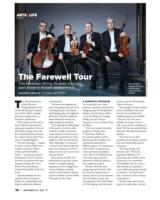
The Emerson String Quartet includes
Ann Arbor in its last appearances.
The Farewell Tour
SUZANNE CHESSLER CONTRIBUTING WRITER
PHOTOS BY JURGEN FRANK
Paul Watkins,
Eugene Drucker,
Philip Setzer
and Lawrence
Dutton.