

E
ngaging young adults in synagogue
participation requires a specific
approach, especially around the High
Holidays.
“We have to make it accessible,
” says
Congregation Shaarey Zedek’s Rabbi
Yonatan Dahlen. “
And that’s really hard.
”
The key, he explains, is blending accessi-
bility with authenticity. For the young adult
population, it can be difficult to not only
encourage synagogue membership, but to
also provide young adults with meaningful
opportunities to become contributing mem-
bers.
At Shaarey Zedek, roughly 200 family
units fall into the young adult demographic
— or the equivalent of 20% of the syna-
gogue’s overall membership. Still, as older
demographics slowly age out, keeping young
members engaged and active within orga-
nizations is essential to the future of syna-
gogues throughout Metro Detroit.
“
Around the High Holidays, we see a ton
of young folks,
” Dahlen says. “But I think we
see them because they’re going with their
parents or grandparents, and they’ve been
asked to do so. It’s meaningful to them, but
I think they’re having different experiences
than their parents or grandparents are hav-
ing.
”
The problem, Dahlen says, is that interests
are often different for younger members.
Priorities are also an obstacle, especially for
young adults who can’t attend services. In
some cases, rather than prioritizing tradition
or attending services on High Holidays,
work often comes first — a reflection of
today’s changing work culture, he continues.
In other cases, raising a young family
makes it difficult to allow time for services,
and it’s often not possible for newer parents
to attend synagogue on High Holidays.
Other young adults simply don’t want to
attend services because they’re too struc-
tured and formal, an experience that young-
er populations can struggle to relate to.
All in all, these issues contribute to ongo-
ing reductions in synagogue membership
nationwide — and keeping younger mem-
bers engaged is essential to long-term lon-
gevity.
“Pew Research Center studies tell us
that synagogue membership is dwindling,
”
Dahlen says. A 2021 Pew report, for exam-
ple, examined why. The top reason, it found,
was that most people simply “weren’t reli-
gious.
” Other explanations included a “lack
of interest” and “not knowing enough to
participate.
”
Synagogue fees were also a concern noted
amongst Jewish leadership, although many
young study participants under 30 were less
likely to report financial barriers than older
participants. So, pricing isn’t a major issue
for young Jewish adults although it may
seem like a logical barrier that keeps people
from enrolling in synagogue membership.
Therefore, how do synagogues work
around these other, deeper concerns?
FINDING MEANING
The first step, Dahlen explains, is tackling
the unique needs of younger members.
“There is a big chunk of people, especially
young adults, who do consider themselves
spiritual,
” he says. “For millennials, we are by
nature distrusting of institutions and organi-
zations. But we’re still looking for something
that will give us meaning in our lives.
”
To navigate this, Dahen says synagogues
must meet young members at their own
levels.
“The bar is really high as far as entry into
synagogue life,
” he explains. “We’ve put a
lot of stock into prayer, which makes sense
because first and foremost, a synagogue is a
place to pray.
”
66 | SEPTEMBER 22 • 2022
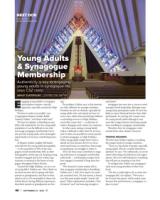
Authenticity is key to engaging
young adults in synagogue life,
says CSZ rabbi.
Young Adults
& Synagogue
Membership
ASHLEY ZLATOPOLSKY CONTRIBUTING WRITER
NEXT DOR
VOICE OF A
NEW GENERATION