

ROSH HASHANAH
42 | SEPTEMBER 22 • 2022
T
he sermons on Rosh Hashanah
and Yom Kippur give synagogue
rabbis the opportunity to
influence the largest number of listeners
— and put rabbis under the most
exacting scrutiny. Rabbis across the
spectrum will try to connect the classical
themes of the season to the lived reality
of their congregants. Any advice about
the lives of congregants, though, might
touch on deep political divisions.
This year, when your rabbi gets up to
speak, do you want him or her to talk
politics?
An argument for avoiding all political
issues has at least two supports:
• The rabbi has earned expertise
in Judaism but might have no special
expertise in current controversies.
• Congregants join synagogues that
reflect their commitments to Jewish
ritual. The congregants might not share
political commitments. A
political sermon inevitably
will make some congregants
feel unwelcome at precisely
the synagogue where they
should belong.
On the other hand, Jewish
educator Deborah Klapper
says, “If you can’t call out evil and call for
good, what’s the point?”
But how to deal with morality without
merely presenting partisan talking
points?
Rabbi Alon Tolwin of Aish HaTorah
Detroit in Oak Park explains, “I don’t
think that it is wise … to
talk about politics, per se.
Yet, with the issues today,
it is very easy to address
the morality that Judaism
teaches. If the congregants
connect the drashah
[teaching] to a partisan
issue, that is their deal.”
Tolwin believes it appropriate to
deepen the discussion when political
partisans pick terminology that makes
complex problems seem simple. For
example, he asserts, rabbis may object to
describing abortion as only a question of
“reproductive rights,” which leaves out
all other considerations.
Rabbi Robert Gamer of Congregation
Beth Shalom in Oak Park deals with
similar concerns.
“I don’t often stray into political
discussions, but I have recently with
regard to the issue of abortion access.
Many congregants did not know there
are times that Halakhah permits, forbids
or even requires abortion,” he says.
“I always talk about any issue from a
strictly Jewish perspective,” he says, “and
I try to present the various
halakhic views.
“During the holidays, I
plan on a sermon about
extremism (on both the
left and the right) and how
that is impacting Jewish
life — from Christian
Nationalism and radical
secularism. I think it is important that
we, as Jews, understand that while there
is a separation of church and state,
that many ‘political issues are really
religious issues. Access to abortion and
contraception are two such topics, but
so are circumcision, shechitah [ritual
slaughter] and more.”
‘POLITICS HAS ITS PLACE’
If some people believe that rabbis should
try to avoid political statements, Joe
Feldman of Bloomfield Hills says, “It
is an important responsibility to bring
politics to the pulpit.”
He particularly welcomes rabbinical
input when organizations have values
attractive to Jews, but also have
leadership “both antisemitic and anti-
Israel.”
Max Kresch, formerly of Oak Park,
now of Israel, warns against
rabbinical overreach. Kresch
observes that last summer,
when he was administering
vaccinations, some religious
Jews would explain either
that their rabbis had ordered
them to get vaccinated
or had prohibited them from getting
vaccinated. While he preferred to hear
the ruling in favor of vaccinations,
Kresch insists that “the only medical
advice rabbis should be giving to their
congregants is ‘Listen to your doctor!’”
As a congregant, Allen R. Wolf of
Bloomfield Hills accepts that
his rabbi will offer guidance
in partisan matters, even if
the advice is imperfect.
“The Torah is supposed to
be a guide for living. A rabbi
is supposed to be a learned
Allen Wolf
Rabbi
Robert
Gamer
Deborah
Klapper
Rabbi Alon
Tolwin
Max Kresch
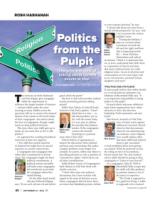
Politics
from the
Pulpit
The pros and cons of
talking about current
events at shul.
LOUIS FINKELMAN CONTRIBUTING WRITER
continued on page 44