

8 | SEPTEMBER 15 • 2022
N
o one mentioned tor-
ture. As my group
walked through
Munich’s Olympic Park, we
stopped at three memorials to
the Israeli athletes
murdered by ter-
rorists during the
1972 games. We
were told that they
died. Our guide
never mentioned
that some were
tortured.
In 2015, an article in the New
York Times revealed that victims’
family members were shown
documentation that indicated
their loved ones had been tor-
tured as well as murdered at the
hands of the Palestinian terrorist
group Black September. Perhaps
our guide, being German, didn’t
say anything because the claims
of torture are still contentious in
Germany. Perhaps it was a detail
she did not know. Fifty years after
the 1972 massacre, her silence fits
the general narrative.
Munich is a city that, unlike
Berlin, does not seem keen to
place plaques, memorials or
markers to highlight the lost Jews
in its history. While touring near
Marienplatz central square with
the Germany Close Up program,
our tour guide stopped to tell
us that we were standing where
Munich’s main synagogue once
stood. She had to tell us because
there was no indication, no
visible record that the center of
Munich Jewish life once exist-
ed. The stumbling stones, brass
plates laid into the pavement near
the last residence of Nazi victims,
so present in Berlin, are currently
banned in Munich.
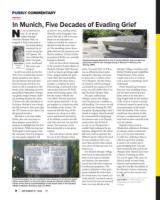
Why are there three memorials
to the murdered Israeli athletes in
Munich’s Olympic Park? Because
it took so long to get things right.
One, a plaque outside the apart-
ment where the Israeli athletes
once stayed, lists their names.
Another, a sculpture by artist
Fritz Koenig, constructed at the
intersection between the Park’s
arenas and housing, again, only
lists the names of those who
were killed. The last memorial
wasn’t opened until 2017. It was
put together in conjunction with
the families of the victims. The
memorial tells the story of the
massacre on a loop on a video
screen and features the history
of the athletes, coaches and offi-
cials who were lost, not just their
names. The massacre, at this
latest memorial, is at last given
context.
The only silence anyone asked
for was at the Olympics them-
selves. Not until 2021, in Tokyo,
was an official moment taken
during the Opening Ceremony
to honor the 11 victims of the
1972 Olympics. But the silence
of omission, which has largely
surrounded the massacre for 50
years, was still visible when I vis-
ited Munich’s Olympic Park.
The park, unlike many
Olympic arenas and villages,
once the games are complete, is
still standing. The venues are still
used and were hosting the 2022
European Championships when I
visited in August. Munich should
be commended for integrating
the massive scale of its Olympic
construction into the life of
its city. As an Olympics fan, I
couldn’t help smiling at the pic-
tograms, designed by Otl Aicher,
that were used to represent the
different sports without the need
for any translation. But I was
more disconcerted than excited,
very aware of what our tour was
there to see.
The Munich Olympic Village,
once home to international ath-
letes, is now home to families
and students, the apartments
turned into full-time residences
for Munich’s population. The
modern utilization of the apart-
ments includes the suite where
the Israeli team once stayed, cur-
rently used by a research associa-
tion. Even if no one was tortured
there, two men did die in the
Olympic Village: wrestling coach
Moshe Weinberg and weightlifter
Yossef Romano. Why anyone
would want to live or work in
such a space is something I don’t
understand.
While Munich’s government
does not want stumbling stones,
and the latest memorial instal-
lation came to be only after a
long-fought battle by the families
of the victims, it seems everyone
in Munich wanted to speak at the
commemoration of the attack.
Only the families of the victims
would have been absent if, after
50 years, a compensation agree-
ment had not been reached at the
very last minute.
Munich is known for its
Oktoberfest celebration. Pavilions
are already under construction.
It is a city far more interested
in collective celebration than in
collective grief. But, perhaps,
it needs to do a better job at
acknowledging both. Like the
three memorials that exist in the
Olympic Park, Munich does have
a history of making an effort.
Try, try, try again. Fifty years on,
Munich needs to keep trying.
Memory and monuments are
imperfect, but like the athletes of
the Olympic Games, continuing
to take part in the exercise mat-
ters.
Jessie Atkin is a Washington, D.C.,
based writer and social media
manager.
MATTHIAS SCHRADER/AP
A memorial plaque for the 11 athletes from Israel and one German police
officer were killed in a terrorist attack during the Olympic Games 1972,
stands at the former accommodation of the Israeli team in the Olympic
village in Munich, Germany, Aug. 27, 2022.
opinion
In Munich, Five Decades of Evading Grief
Jessie Atkin
Times of
Israel
CC DR. AVISHAI TEICHER VIA WIKIMEDIA
Kolehmainenweg Memorial to the 11 Israeli athletes and one German
policeman killed in the hostage-taking in Munich in 1972 by Fritz
Koenig, 1995.
PURELY COMMENTARY