

OBITUARIES
OF BLESSED MEMORY
P
erel (Paula) Schulkind could be
the heroine of a novel — a coura-
geous and resourceful woman who
survived the Holocaust and became the
matriarch of a large and loving family. Her
indomitable optimism and generous spirit
touched the lives of all who knew her.
Perel, the mother of Rebbetzin Chaya
Sarah Silberberg of Bais Chabad Torah
Center in West Bloomfield, passed away on
July 13, 2022, at her daughter Freidy’s New
York home in Mill Basin, Brooklyn, sur-
rounded by loved ones. She was 98.
Perel was born in 1923 in Krakow,
Poland, the oldest child of Eliyahu and
Simcha (Fraida) Stern. While she and her
siblings attended Jewish schools and sum-
mer camps, they learned the importance
of helping others from their father, who
risked his life to bring food and clothing to
those in need amid the growing waves of
antisemitism in German-controlled Poland.
When she was 17, the Nazis forced
Perel and her family to leave their home
in Krakow and go to another part of
Poland where they were forced to wear
yellow armbands. Her resourceful mind
and non-Jewish features — blond hair
and blue eyes — enabled her to evade the
Nazis and travel to the town of Wisznicze,
where she sent for the rest of her family.
The safe haven proved only tempo-
rary as the Nazis gained more power in
Poland. Perel and her family were in a
state of constant panic, running from one
place to the next to avoid capture. In the
town of Bochnia, they lived in an attic
and slept five in a bed until the Germans
came searching for her brother, and it was
time to flee again.
Eventually they were captured by the
Nazis, and Perel’s sister Faigel was killed
that day along with 700 other Jewish
teens. Perel was taken to Auschwitz,
where she suffered for two years, sub-
sisting on bits of bread and watery soup.
At night she slept on a board shared by
several girls.
Every day as she performed her job of
filling grenades with powder,
she watched the Nazis take
groups of people away to be
murdered, never knowing if
her turn was coming. Despite
her meager rations, she shared what lit-
tle she had to save others who were sick
or starving, including a young woman
named Edja.
When the Nazis evacuated Auschwitz
to evade the approaching Russian army,
Perel was part of the infamous “Death
March” to Germany, where 15,000 Jews
died. She survived the deadly journey,
together with a nightgown she had “pur-
chased” in exchange for bread. Deathly ill
in the camp at Neustadt-Glewe, she went
to the infirmary and she saw the women
lying there naked in bed. She returned to
her barrack to retrieve that nightgown to
preserve her remaining dignity. During
that small window of time, the Nazis shot
all the patients in the infirmary. That
nightgown saved her life.
After the war ended, she went to
Krakow with Edja, who gave her the
means to leave Poland. Perel’s entire
family had died during the Holocaust,
with the exception of her uncle by mar-
riage, Yaakov Kopel Schulkind, whose
wife and children had been killed by the
Nazis, her cousin Itche Schacter (and a
few others). Together the three of them
traveled to a displaced persons camp in
Germany, where she and Schulkind were
married. In 1949, the couple finally left
“accursed Germany” and moved to the
United States. They made their home
in Brooklyn, N.Y., where they lived in
Williamsburg for 12 years before settling
in Borough Park.
NEW GENERATIONS
Although grateful for surviving the war and
being able to start a new life, their hearts
were filled with sorrow over the brutal
loss of their families. Their pain ultimately
began to ease with the birth of their two
daughters, Chaya Sarah and Fraidy, named
after the couple’s respective mothers.
The couple’s happiness continued to
increase as their daughters married and
had children of their own. Perel’s great-
est source of joy was her ever-growing
extended family of in-laws, cousins,
grandchildren, great-grandchildren and
great-great-grandchildren, who lovingly
called her “Bobby,” the Polish/Yiddish
word for grandma.
“She would often say in Yiddish, ‘one
may not complain,’ and she lived up to
that motto,” said her grandson, Rabbi
Shneur Silberberg of Bais Chabad Torah
Center. “Bobby did not allow her dark,
painful past to paint the world she chose
to create for herself.”
Instead of bemoaning the past, Perel
turned her experiences into life lessons
for her family. Receiving help from the
young woman whose life she had saved
by sharing her bread was a reminder to
share what you have with others who
need it more. To demonstrate the power
of an encouraging word when someone
feels hopeless, she would recount the
time a stranger stopped her from ending
A Life of Horror and Hope
RONELLE GREIR CONTRIBUTING WRITER
56 | AUGUST 4 • 2022
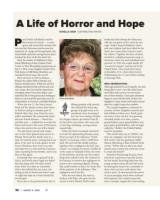
Perel Schulkind