

38 | AUGUST 4 • 2022
D
ebra Meyerson, a Metro Detroit
native, was a Stanford University
professor and a healthy, athletic
mother of three when her life was turned
upside down in 2010 by a severe stroke that
nearly killed her.
The stroke left Meyerson paralyzed on
her right side and with no speech at all.
Suddenly, her roles as a professor, mother
and wife were seemingly impossible to fulfill.
Instead of giving up, Meyerson, now 65,
fully committed to a long and tedious recov-
ery process. She learned how to walk with a
limp and had limited speech that came with
great effort. Still, Meyerson could once again
drive, travel and take care of herself.
The problem, however, is that aphasia, or
the loss of ability to understand or express
speech caused by brain damage (such as
from a stroke) meant that working in aca-
demia was no longer feasible. “That was a
huge blow as so much of her life — and her
identity — was tied to that work,
” explains
her husband, Steve Zuckerman, 62.
Meyerson and Zuckerman weren’t ready
to give up, though. To help raise aware-
ness for strokes and stroke recovery, they
launched Stroke Onward in 2019 as a pro-
fessional activity that would help them and
the thousands of people they could reach
through it.
Now, Meyerson, a stroke survivor, and
Zuckerman, her care partner, devote their
time to helping others navigate strokes and
stroke aftermath. They help people around
the country rebuild their identities and lead
rewarding lives, regardless of any limitations.
Meyerson also authored the book Identity
Theft: Rediscovering Ourselves After Stroke
(Andrews McMeel Publishing) to share her
inspirational journey with others.
BIKING ACROSS THE COUNTRY
Currently, Meyerson and Zuckerman are in
the middle of a 100-day tandem bike ride
across the country to generate support for
stroke survivors. They began on the west
coast in Astoria, Ore., and plan to finish on
the east coast in Boston, Mass.
On Aug. 5, Meyerson and Zuckerman
will be riding through Michigan and will
be guest speakers at an event being held at
Detroit Axe-The Yard in Corktown, where
stroke survivors will share their stories. The
event will include games, food and more.
“I think it’s safe to say that if Debra had
not had a stroke, we would not be doing
this,
” Zuckerman says.
While the pair, who now live in Portola
Valley, Calif., have a mutual interest in
cycling and often rode through Ann Arbor
with their kids when they lived in Michigan,
“100 days is definitely pushing the envelope
for us,
” Zuckerman says.
Previously, they’ve done shorter rides that
lasted up to three weeks. The current ride,
however, is a new challenge that they’re con-
fident will bring stroke awareness nation-
wide.
“
Astoria is a classic starting point for
cross-country rides, with several routes
west that are beautiful and good for biking,
”
Zuckerman says.
Zuckerman and Meyerson are riding in
tandem and are joined by a close friend who
had a traumatic brain injury, a second stroke
survivor and two summer interns from
Washington University in St. Louis.
“They are supporting our work to orga-
nize both online and in-person events
and creating content for social media and
other communication efforts,
” Zuckerman
explains of the interns. “
Around their work,
each is generally riding every other day.
”
Zuckerman says the group created their
own custom route built around routes gen-
erated by Adventure Cycling Association, a
nonprofit that focuses on travel by bicycle,
and around places they believed would offer
beautiful riding. Along the way, they stop
at larger cities like Detroit to hold events to
support the mission of their work.
Over the 100-day trip, they alternate
between sleeping in an RV
, tents and motels.
“We made a conscious decision that we had
to create a fixed schedule to be able to orga-
HEALTH
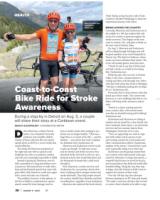
During a stop-by in Detroit on Aug. 5, a couple
will share their story at a Corktown event.
Coast-to-Coast
Bike Ride for Stroke
Awareness
ASHLEY ZLATOPOLSKY CONTRIBUTING WRITER
Steve Zuckerman
and Debra
Meyerson