

JULY 21 • 2022 | 19
HIGHER GAS PRICES
Yad Ezra delivers food to some
clients — a service provided
by volunteers on weekends.
To date, volunteers have not
expressed concern about fuel
costs, according to Mechnikov.
The agency pays JFS to deliver
food to 300 families and indi-
viduals during the week.
“Jewish Family Service
spends a lot of money every
year ensuring that people can
get to where they need to go,
through 30,000 or so rides.
While we have adjusted our
budget numbers, it’s fair to say
that paying this much more
for gas is not sustainable.
Something’s got
to give,” says Jim
Janetzke, chief
operating office
at JFS.
JARC operates
21 group homes
for individuals
with developmental disabili-
ties. “We have a van at every
location, getting people not
only where they need to go
but where they want to go,”
says Shaindle Braunstein,
chief executive officer. JARC
is planning car
trips in advance
to achieve more
efficient routing
and reduce gas
usage.
Gesher (for-
merly JVS +
Kadima) is feeling the pinch.
“We are constantly on the
road, engaging people at work,
at home and in the com-
munity so we can’t decrease
the amount of transporta-
tion provided,” says Aubrey
Macfarlane, executive vice
president and chief operating
officer. She adds that Gesher
has 60 or 70 vans that trans-
port clients to work sites from
Gesher/JVS locations.
In addition, Gesher oper-
ates 22 group homes whose
residents are transported by
the agency. “We have had
an increase in housing and
food costs. There is a huge
direct staff crisis. The state
increased payment for these
positions but hourly workers
still struggle.
We haven’t had
a good reso-
lution to this,”
Macfarlane says.
During the
height of the
pandemic, JARC
used food delivery services
for its group homes. Now
the agency makes bulk pur-
chases online, which helps
to reduce expenses and food
waste. With these savings as
well as tracking grocery store
prices and using coupons,
Braunstein says that costs
have stayed about the same.
Braunstein notes that insur-
ance rates are going up and
that the agency has provided
pay increases over the past
two years to help recruit and
retain hourly staff. JARC is
offering some hourly workers
three 12-hour shifts to help
them reduce commuting costs
with fewer workdays and
assisting with gas cards and
Uber rides.
JARC’s Shulman Hardship
Fund helps employees with
special needs, which some-
times entails transportation
assistance — gas and car
repairs — as well as other
items.
In addition to providing
weekend food delivery for
Yad Ezra, volunteers help
JARC and JFS with programs
and other support for clients.
Braunstein says that JARC is
doing more programs online,
which reduces the need for
travel. According to both
JARC and JFS, gas prices hav-
en’t had a major impact on
their volunteers.
The same
is true for the
National Council
of Jewish Women
(NCJW), which
relies on volun-
teers to deliver
Meals on Wheels
to elderly individuals. “We
are very grateful to our vol-
unteers,” says Susan Gertner,
NCJW executive director.
Shaindle
Braunstein
Aubrey
Macfarlane
Jim
Janetzke
Susan
Gertner
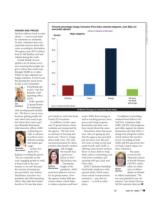
U.S. BUREAU OF LABOR STATISTICS
12-Month Changes in Consumer Price Index