

46 | JUNE 16 • 2022
ERETZ
A
vi Gruber, 72, moved back to
Israel in 2016 with his wife, Abby.
Although he was born and raised
in Israel, he still had to adjust to his “new”
surroundings after leaving the warm
community of Beverly Hills, Mich. They
settled in Tel Aviv but recently moved to
Hod HaSharon, where the pace feels a little
more like Michigan.
JN: When did you leave Israel?
Avi: I lived in Israel until I was 26, when I
settled down in Detroit.
JN: What drew you to Michigan?
Avi: I met my wife in Florida, but she
was from Birmingham, Mich., and that’s
how I ended up there. We first lived
in Birmingham and then moved to
Southfield and then to Beverly Hills. I
lived in Michigan for a total of 42 years.
JN: What made you decide to move
back to Israel?
Avi: There’s a dream that every Israeli has
when they leave Israel. At the beginning,
you are ready to go back to Israel; but as
time goes by, you settle down and all these
things get put on the back burner.
Our two sons, Joshua and Jordan, had
both made aliyah and all our grandchil-
dren live in Israel, so when we thought
about that, we decided to live near our
grandchildren.
JN: What shul and schools did your
family attend in Michigan?
Avi: I was affiliated with The Shul in
West Bloomfield, where Rabbi Shemtov is
the rabbi. I was with him from the begin-
ning when the minyan was in his base-
ment all the way through until the time
I left. My kids went to Sunday school at
Beit Achim Southfield, where they both
had their bar mitzvahs.
JN: What did you do professionally
when you lived in Michigan?
Avi: I had a well-known auto repair shop
called Avi’s Auto Care on Northwestern
Highway in Farmington Hills. I also had
a Mobile gas station on Northwestern and
Orchard Lake for five years.
JN: What do you do to occupy your
time?
Avi: I’m an outdoors person. I do a lot of
hiking all over Israel with different groups.
We travel anyplace we can. For example,
I’m just taking off for four or five days
with a friend to Cyprus, just to have a little
bit of a different environment.
JN: How is it living back in Israel
now after so many years of living in the
diaspora?
Avi: It is a big adjustment for me and my
wife. It’s not easy, but you learn to adjust.
You do the best of it, but you have to be
determined because if you’re not, you’re
not going to make it.
JN: Do you still have family living here?
Avi: My mother, who is in her 90s, lives
here. My brother and his children and
grandchildren also live here, as do my sons
and their families.
JN: What do you love about being back
in Israel?
Avi: I love being with my people and
being close to my family. I love the
environment. I joined a soccer team,
called “walking football,” which is made
up almost entirely of foreigners and some
Israelis.
JN: Is there anything you miss about
living in Michigan?
Avi: I miss the weather. Because of my
business, snow was a big part of my life.
I loved waking up in the morning and
cleaning our neighbors’ and my in-laws’
driveways with my plow and going cross-
country skiing.
The other thing I miss is the Jewish
Community Center, which was a big
part of my life. I loved the sports and the
environment and seeing my friends. I also
loved my neighborhood in Beverly Hills.
Detroit was very good to me in many
different ways, but I realized a long time
ago that it wasn’t home. Here, I feel a lot
more comfortable.
JN: Do you have any advice for people
thinking about making aliyah?
Avi: You should make aliyah, but you have
to prepare yourself in many different ways,
especially emotionally. If you’re not ready
for all the difficulties you will encounter,
that’s not good. It helps if you have some
money saved or a profession in which
you can continue earning an income. Get
yourself ready and don’t dive in with your
eyes closed.
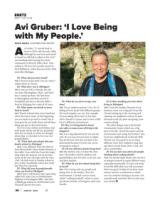
Avi Gruber: ‘I Love Being
with My People.’
AVIVA ZACKS CONTRIBUTING WRITER
Avi
Gruber
MEET THE OLIM