

JUNE 9 • 2022 | 9
present day palatable. I appre-
ciated the balance the curators
appeared to strike between the
“lachrymose” school — Jewish
history as a series of disasters —
and the long periods of creativity,
stability and autonomy enjoyed
by Jews from North Africa to
Middle Europe. The exhibit also
tries hard to restore women to
the Jewish story: I counted at
least four main displays center-
ing women.
But Mosaic, subtitled “Identity
and Culture in Our Times,
” was
to me the most engaging of the
three main permanent exhibits,
and the one that succeeds the
most in transforming this from
a “museum of the diaspora” to a
museum of world Jewry. There
are crowd-pleasing touches like
a wall (and, on the first floor,
an entire temporary exhibit) on
Jewish humor (trust me, Seinfeld
is as big a phenomenon here as it
is back home), and the kinds of
interactive features that I suspect
are more intriguing to kids than
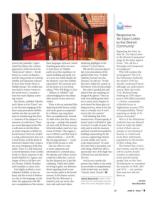
adults. There is a wall dedicated
to Jewish literature, from Cynthia
Ozick to Clarice Lispector to the
Israeli Nobelist S.Y. Agnon, and
images of Jews in all their vari-
ety: Persian, Turkish, Brazilian
and Canadian, to name a few.
One highly symbolic corner
celebrates Yiddish, on the one
hand, and the revival of Hebrew
as a day-to-day language, on the
other. My arguments with Elli
are a recapitulation of the tension
these languages represent. Israel’s
founding generation was seen
to look down on Yiddish,
partly out of the expediency of
nation-building and partly out
of a none-too-subtle disdain for
the diasporic ways that Yiddish
represented. The museum tack-
les this head on in one kiosk,
asking “Who Will Reign in Zion
— Hebrew or Yiddish?” and
acknowledging how the debate
often turned vicious and even
violent.
There is also an animated film
depicting Jewish literary, artistic
and music greats accompanied
by a Hebrew rap song about
their accomplishments. I found
it a little ironic that they chose a
rap song — perhaps the popular
art form with the fewest success-
ful Jewish makers (and yes, I am
aware of Drake). Then again, it
was in Hebrew, and that kind of
cultural synthesis — and, OK,
flat-out appropriation — is part
of the Jewish mosaic as well.
Like any effort to cram
so many arguments and
information in a limited space,
the Identity and Culture section
could feel a little thin. And yet
for this diaspora Jew, it also felt
validating. I didn’t feel chided
for living in galut, nor defensive
about regarding Israel as just
one of many paths in the Jewish
journey. In the history section,
Israel, like the Holocaust, is
treated in just one room, this
time with wall-sized videos
displaying highlights of the
country’s 74-year history.
Elli said the museum played
fair in its presentation of the
global Jewish story. “It didn’t
celebrate Zionism nor diss
Zionism,
” he told me. “It told
that story within the context of
the history of the Jewish people.
”
But when I goaded him and
asked if that was satisfying, he
dropped the gloves: “One can
walk away thinking that there
are so many more chapters to
write about the future glory of
diaspora Jewry, when in fact the
story is virtually over. It won’t
survive the 21st century.
”
I left thinking that if the
museum has a Zionist agenda, it
doesn’t need a wall label or “gate
of return” to make its point. You
only need to exit the museum
and find yourself surrounded by
buildings representing the life
sciences, engineering, biotech,
security studies and “cereal
crops improvement.
” To catch
the train back to Jerusalem, you
walk along a bluff that offers a
spectacular view of the high rises
of Ramat Gan and downtown
Tel Aviv.
And as you consider the
present-day vitality or the nearly
inconceivable accomplishments
of the Jewish state, you think,
“Touché, Israel. Touché.
”
Andrew Silow-Carroll is editor in chief
of the New York Jewish Week and senior
editor of the Jewish Telegraphic Agency.
letters
Response to
‘An Open Letter
to the Detroit
Community’
Regarding the letter on
May 26, “An Open Letter
to the Detroit Community”
(page 8) the letter signers
wrote, “We call for a
thorough and transparent
investigation.”
Who will conduct the
investigation? The U.N.,
the Palestinian Authority,
the media? CNN has
already condemned Israel,
although one authoritative
source offers the truth:
“Col. Richard Kemp:
Nothing in CNN report
proves IDF killed journalist
— Former commander
of British forces in
Afghanistan accuses CNN
of irresponsibility, ‘flimsy’
reporting on death of Al
Jazeera journalist.”
Why is it the Palestinian
Authority has not allowed
Israel to study the bullet,
review if there was an
autopsy or any forensics?
Reason: to control and
incite their unfortunate
population for the benefit
of their ruling class.
The bottom line is facts
don’t matter, and the event
will be used by Israel’s
enemies to undermine
Israel and the Jewish
people, but on this Yom
Yerushalayim we remember
the miracles of 1948, 1967
and 1973 — our enemies
then and now will not
deter us.
— Ed Kohl
West Bloomfield
ANDREW SILOW-CARROLL
A wall at ANU-
Museum of the
Jewish People in Tel
Aviv honors Jewish
literary greats.