

46 | JUNE 2 • 2022
ARTS&LIFE
FILM
A
t the age of 12, Jewish filmmaker
Michael Chait, who grew up in the
West Bloomfield and Bloomfield
Hills area, wanted to be an actor. Other days,
he wanted to be a pilot like his father. “I grew
up with movies and I always liked aviation,
”
Chait, 37, says.
Yet everything changed when Chait saw
The Rock, a 1996 film directed by Michael
Bay. “Something just snapped in my head,
”
recalls Chait, who to this day is impressed by
the film’s camera work and directing style. “I
was like, ‘Oh, this is what you want to do.
’”
Now set to release World War II action
film Wolf Hound, his directorial feature debut,
on June 3 through Lionsgate’s Grindstone
Entertainment, Chait, who currently lives
in West Bloomfield after 11 years living in
Chicago, is still inspired by the films of his
childhood.
“I realized how much directing really
tells the story even more than the script
sometimes,
” he says of watching The Rock. “It
totally changes how an audience experiences
a film.
”
Having poured his blood, sweat and tears
into Wolf Hound — his self-described process
— Chait wants viewers to have that same
experience as he had watching The Rock.
A CHANCE EXPERIENCE
As a 2006 graduate of Columbia College
Chicago, where he met his best friends (and
later crew members for Wolf Hound), Chait is
no stranger to the filmmaking world.
He worked on films all through high
school and was later selected by Steven
Spielberg and Mark Burnett as one of the
final top 50 directors out of 12,000 filmmak-
ers for the premiere episode of Fox’s On The
Lot (2007).
Prior to embarking on Wolf Hound, Chait
was directing commercials and music videos
for 15 years. In 2010 and 2012, he tried to
get two other feature films going, but nei-
ther worked out. Then, in 2013, inspiration
struck at an unlikely place.
He was directing a commercial for the
Yankee Air Museum at Willow Run Airport
in Ypsilanti, which advertised taking rides in
a restored B-17 bomber. Chait was familiar
with the plane, but never spent much time
with it. “When I stepped onto it, it was like a
movie moment,
” he recalls. “I put my foot in
the door and a rush of emotion hit me.
”
On the same plane many decades back,
Chait envisioned 18- and 19-year-old kids
standing in the exact spot during World
War II, fighting the Nazis and fighting for
freedom.
“I thought, ‘I have to do this justice,
’” he
remembers.
Doing justice, however, was for a commer-
cial only, but Chait knew deep down that the
90-second creation could be an entire movie.
With only nine B-17 bombers left in the
entire world, Chait had a unique slice of his-
tory to work with that had been seldom told.
BUILDING A STORYLINE
Yet Chait didn’t know how unique that
history truly was until his writing partner,
Timothy Ritchey, discovered a story on
Wikipedia about a German Luftwaffe squad-
ron called KG 200 that neither had heard of.
“They were a special forces group that
forced down American and British planes
and captured their crews,
” Chait explains.
“They were very mysterious and there was
hardly any information on them.
”
Pursuing the story further, Chait won-
dered if they could create a fictional version
inspired by the truth. While the German
squadron was ultimately unsuccessful, what
if their success had changed the course of
the war? And what if the hero was a Jewish-
American fighter pilot? It seemed to work
perfectly.
“
All the dots were connecting,
” Chait says
of Wolf Hound. “This is the movie we had to
make.
”
It was the ultimate story, and one that
Chait and Ritchey began to bring to life and
film in 2018.
“It was fighting the greatest evil, the
Nazis,
” Chait explains. “I was passionate
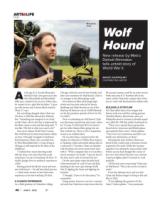
New release by Metro
Detroit filmmaker
tells untold story of
World War II.
ASHLEY ZLATOPOLSKY
CONTRIBUTING WRITER
Wolf
Hound
Michael B.
Chait
COURTESY OF MICHAEL CHAIT