

28 | JUNE 2 • 2022
J
ournalist Stephen
Henderson judges that
“the political climate has
worsened over the last decade
or so.” Henderson, along
with many other observers
of American politics, finds it
disturbing that “people have
started to come apart” over
their disagreements.
Friends and relatives do not
know how to talk with each
other across their venomous
partisan divisions. Activists
and leaders routinely break
the norms of political behav-
ior; ordinary citizens hear and
use increasingly violent lan-
guage; protesters turn violent;
we wonder if we can count on
impartial elections or peaceful
transfers of power.
People just cut their ties
with former friends who hold
opposing political opinions.
But Henderson has long
enjoyed a close friendship with
Nolan Finley, despite their
political disagreements. About
15 years ago, when Finley was
editorial page editor of the
conservative Detroit News and
Henderson had the equivalent
position at the liberal Detroit
Free Press, they often attended
the same news events; program
planners would invite them
to discuss their disagreements
in public forums. Finley and
Henderson liked to rehash
those events at the bar after-
wards.
In the ensuing years, they
have not drawn any closer
politically. Both men say, “We
strongly disagree about almost
everything.” About that they
agree. They also agree that
Americans need to find a way
to talk with and listen to each
other, even about politics.
Finley says, “There is
too much hate in America
today, fueled by our pol-
itics.” Henderson agrees:
“Confrontation happens when
civility breaks down, and we’ve
seen things turn increasingly
uncivil and violent in the past
decade. We’re fighting for our
soul as a country, and we need
to act now before it’s too late.”
So, they started, in Finley’s
words, “my conservative
friends and acquaintances,
his progressive friends and
associates, to bring them
together in small groups over
bourbon, in local bars, just to
talk together.”
The two friends would
model techniques for
disagreeing respectfully.
Finley and Henderson came
to believe that they could help
teach civility as an outgrowth
of their own political dialogue.
In the years of their unusual
and unlikely friendship, they
figured out how they had built
a successful and productive
relationship when they hold
opposing perspectives on
almost everything.
As more people angled
for invitations, the meetings
outgrew that informal
structure. In 2020, Finley
and Henderson started
an organized Great Lakes
Civility Project, to scale
their efforts up to reach the
general public. With the help
of sponsors, Delta Dental
Plan and Huntington Bank,
the Great Lakes Civility
Project has now conducted,
in Finley’s description, “54
programs at community
groups, classrooms, civic
organizations, churches.” (For
a list of upcoming events, visit
greatlakescivilityproject.com.)
Finley identifies the
operating assumption that
makes civil discussions
possible: “That all people,
all good people, come to
their opinions in the same
way. They take the facts, the
information, the data; they
run it through the filters of
their values and experiences;
and they come up with their
opinion.
“If it is different from yours
or mine, that doesn’t make
them evil. It doesn’t make
them stupid. It doesn’t make
them sinister in any way. They
just have different experiences
or whole different values.
Those values are just as valid
as yours. You may never agree
with them.”
When we talk with
people with other political
commitments, he says, “We’re
not asking you to reach
consensus, just to develop
respect for the other person
and their viewpoints. Agree
with their right to hold their
views.”
According to Finley, that
mindset reduces suspicion and
saves us from assuming that
“we know something about
people … based on what we
think we know about their
political views. And once you
sit down talking, the more we
talk to each other, the more we
understand each other.”
To have that civil discus-
sion, we have to “check our
self-righteousness,” he says.
We have to recognize we
might learn something. “If you
know that you have nothing to
learn … you won’t learn any-
thing,” he adds.
THE CIVILITY PROJECT IN
THE JEWISH COMMUNITY
In that first year, during the
COVID-19 lockdown, the
Civility Project did a Zoom
program for the JCRC/AJC
(the Jewish Community
Relations Council/American
Jewish Committee). Rabbi
Asher Lopatin, executive
director of JCRC/AJC, said
there were about 40 partic-
ipants on Zoom, including
continued on page 29
OUR COMMUNITY
Talking and listening across
the political divide.
Let’s Be Civil
LOUIS FINKELMAN CONTRIBUTING WRITER
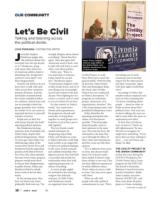
Nolan Finley, veteran
editorial page editor of
the Detroit News, and
Stephen Henderson, host
of Detroit Today.