

ON THE COVER
I
f you’re born in Ukraine, but you have Jewish
roots, most likely your family will have an inter-
weaving of Ukrainian and Jewish traditions. My
father is Jewish, and this means that my childhood
was full of foods such as forshmak (Jewish herring)
and matzah. Every year, we celebrate Passover and
Rosh Hashanah. We cherish and honor the memory
of our origin and know all of our relatives up to five
generations back.
For us, family comes first. Six years ago, I took part
in the “Book of Generations” project in Israel. As part
of the project, my family’s historical narrative was
reconstructed. In the process of collecting informa-
tion about my ancestors, I was given a questionnaire
to fill out. It contained a section called “evacuation.
”
Who from my family was evacuated during World
War II? Where were they evacuated? How did they
manage to survive in such a difficult financial situa-
tion? What were their strongest memories of the war?
With my father’s help, we were able to fill out
the questionnaire. He told me the story of how the
women and children in our family were evacuated
from Kharkiv to Uzbekistan and the Ural Mountains
in 1941. There, my grandmother worked as a hospital
nurse for four years. The most difficult thing for them
was to be in a non-native place, to be separated from
loved ones, from their husbands, to eat unusual food
and live in a different climate. Their strongest memo-
ries were of the kindness of people of solidarity.
My family’s reason to survive was simple: to guar-
antee the future of their children.
Speaking about these topics filled me with an unex-
plainable bitterness. How could my family go through
this? Yet the words “war,
” “evacuation,
” “separation
from loved ones” and “survival” didn’t sound real to
me. The only way to understand the horror of war, to
understand how a person feels in an evacuation, is to
go through it yourself.
One woman’s story
of escaping —
and surviving —
the bombing of
Kharkiv, Ukraine.
IANA SYROTNIKOVA SPECIAL TO THE JEWISH NEWS
TRANSLATED BY ASHLEY ZLATOPOLSKY
CONTRIBUTING WRITER
12 | JUNE 2 • 2022
Dispatch
from
Dnipro
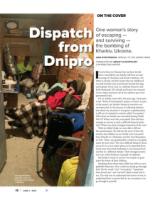
COURTESY OF IANA SYROTNIKOVA
Iana Syrotnikova
uses the phone in
her basement shelter
in Kharkiv.