

OUR COMMUNITY
34 | MAY 26 • 2022
I
t looked like any other funer-
al procession, except there
was no hearse and no corpse.
Volunteers in a small convoy of
cars from Congregation Beth
Shalom in Oak Park to Hebrew
Memorial Park in Clinton
Township were carrying old
prayerbooks and other printed
materials containing the name of
God. According to Jewish tradi-
tion, these need to be stored or
buried, not trashed or burned.
Such items, which can include
everything from old, irrepara-
ble Torah scrolls and worn-out
prayer shawls to primers intro-
ducing children to prayer, are
known collectively as shaimos, or
“names.
” The practice of burying
them stems from Deuteronomy
Chapter 2, where the Israelites
are ordered to blot out and
destroy the names of the gods of
the nations they conquer, but not
to treat God in the same way.
“Sacred texts should not be
discarded in the garbage,
” said
Beth Shalom’s spiritual leader,
Rabbi Robert Gamer.
For thousands of years, Jews
have been storing or burying
such materials in spaces that
became known as genizas, from
the Hebrew verb l’g’noze, to stash
or store away.
The renowned Cairo geniza,
discovered in 1896, was a shaft in
an ancient synagogue wall where
all kinds of materials written in
Hebrew were stored. Because of
the dry environment, the items,
dating back to the 1100s, did not
decompose; they proved to be a
historical treasure trove.
Beth Shalom had 103 cartons
of old printed materials, includ-
ing full sets of prayerbooks last
used in the 1980s, benschers
used for the grace after meals,
old library books and texts from
the religious school. Much of
the material had been in the
synagogue’s basement and had
been damaged in the 2014 flood,
but there was also a complete
Talmud in good condition.
Other materials came from con-
gregants and others who lived in
the neighborhood and had heard
about the geniza project.
“We looked at more than
3,000 books to decide what we
could recycle and what had to be
buried,
” Gamer said. “We tried to
give things away, but not much
was taken.
” One reason is that
many Hebrew texts, including
the Talmud, are now available
free online. People don’t need
the physical books as much any-
more, he said.
Some congregations bury
shaimos in a plot on their own
grounds. In Detroit, most such
materials are interred at Hebrew
Memorial Park in Clinton
Township, under the auspices of
the Hebrew Benevolent Society.
Beth Shalom’s executive director,
Shira Shapiro, worked with cem-
etery officials; once they knew
the number of cartons and their
dimensions; cemetery workers
were able to prepare a long,
narrow plot just large enough to
handle the materials.
A dozen synagogue members
joined Gamer and Cantor Sam
Greenbaum in a brief ceremony
in the synagogue’s lobby before
loading the cartons into cars and
unloading the cartons into the
prepared plot.
Burying books is ecologically
responsible, Gamer said. The
books will return to the earth
to enrich the soil, which will be
used to grow trees, which will be
used to make more books.
A Proper Burial
for Holy Books
Beth Shalom buries old books
containing the name of God.
BARBARA LEWIS CONTRIBUTING WRITER
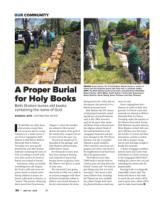
ABOVE: Aryeh Gamer, 15, of Huntington Woods lowers a carton of
books into the prepared grave with help from a cemetary staffer.
LEFT: The Beth Shalom book burial team included (from left) Rabbi
Robert Gamer, Yefim Milter, Aryeh Gamer, Cantor Sam Greenbaum,
Marie Slotnick, Sarah Reisig, Aaron Pickover and Glen Pickover.