

22 | MAY 26 • 2022
I
f you’re driving an electric or hybrid
vehicle around Kalamazoo and need
some charging power, you could head to
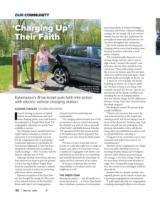
the parking lot at Temple B’nai Israel. The
congregation maintains two power lines
available to anyone.
The charging station, installed last June,
might impress onlookers as strictly an
expression of environmental concerns,
but the congregation also is expressing a
modernized approach to spirituality. Its
introduction happened in what has been
designated a shmitah year, according to
Torah teachings — 2021-22 in line with the
Hebrew calendar year of 5782.
Although shmitah years historically have
been observed as times to give the ground
a rest by leaving it fallow, Temple B’nai
Israel has extended the concept to address
current concerns in nature by promoting
relief from carbon emissions.
National recognition of the dual objec-
tive has brought the temple $1,500 as one
of six national winners of the Interfaith
Power and Light Cool Congregations
Annual Award for Leadership and
Sustainability.
“The charging station became part of the
conversation when we started discussing
the shmitah year and our role as stewards
of the Earth,
” said Rabbi Simone Schicker.
“We questioned what that means outside
of the land because there’s argument that
shmitah is not only about the biblical land
itself.
“We have a Green Team that took on
actions we could take right now to make an
impact, and a piece of it was that we have
a number of congregants with electric cars
and hybrid cars who felt it was something
that would both benefit the immediate car
nation and be a statement of our values.
“It became a statement that we have
responsibility to our planet and to our
neighbors as well.
”
THE GREEN TEAM
Steering the project — and all temple envi-
ronmental projects — is Green Team leader
Steven Bertman, professor of environment
and sustainability at Western Michigan
University and former volunteer building
manager for the temple. He is an environ-
mental chemist who also implements his
principles at home and advocates for con-
servation throughout the community.
Part of the impetus for developing the
charging station came from learning about
financial incentives offered by a local
power company.
“I’m constitutionally disposed to con-
serving energy, and ever since I was in
high school, I wanted solar panels,
” said
Bertman, who has them installed on his
own home. “Renewable energy seemed
like it was a no-brainer and, 40 years later,
when we’re still burning fossil fuels, I final-
ly bit the bullet and bought an electric car.
“I think for a lot of people, the barrier
to getting an electric car is that it’s differ-
ent. We have to learn a new thing. That
certainly was part of it for me. I got the car
and learned all the things I needed to do,
including the use of charging options —
how fast vehicles charge and the differences
between wiring. That’s how I learned about
the rebate program.
”
The program covered 90 percent of the
temple installation.
“There’s a fee structure that covers the
cost of the electricity so the temple isn’t
making a profit, but it’s not taking a loss in
terms of the electricity,
” Bertman said. “
Any
driver can pull into our parking lot, scan
payment information with a cell phone,
using either an established account or cred-
it card identification, and plug in.
“
A big part of my motivation was to raise
awareness and make it less scary to try
something new.
”
Members of the congregation can charge
their cars while attending services or
meetings, thereby taking care of religious
interests while vehicles are powering up.
On average, a two-hour charge would cost
the user about $3.64 for some 60 miles in
range. For a comparable range using gaso-
line, the current cost in Michigan would be
about $8.78.
Jennifer Odza is a temple member who
regularly powers up her vehicle at times she
is pursuing congregational commitments.
“I really appreciate that our congregation
is making meaningful efforts to be environ-
OUR COMMUNITY
Kalamazoo’s B’nai Israel puts faith into action
with electric vehicle charging station.
‘Charging Up’
Their Faith
SUZANNE CHESSLER CONTRIBUTING WRITER
Jennifer Odza charges
her vehicle at Temple
B’nai Israel.
B’NAI ISRAEL