
MAY 19 • 2022 | 103
ARTS&LIFE
POETRY
J
anet Ruth Heller likes to
joke that her first publisher
was her first-grade teacher.
It happened after the woman
gave a poetry writing assignment
to Heller’s entire Milwaukee class
and learned of the many poems
the youngster had written. The
teacher especially liked a verse
about the emerging poet’s flying a
kite with her dad, mimeographed
it and gave a copy to each of the
other students.
“Twenty-five copies of purple
ink,
” Heller happily recalled.
Some 65 years later, Heller hap-
pily has released her fourth poetry
book, Nature’s Olympics (Wipf and
Stock Publishers), which uses out-
door images to probe penetrating
ideas, some delving into Judaism.
“I have been devoted to nature
since I was a little girl,
” said Heller,
a retired university professor
living in
Portage. “My
dad taught
me about trees and plants
and stars and animals, and I
absorbed his love of nature.
“The poems in this book were
written over a lot of my life. The
oldest poems were written when I
was an undergraduate in college.
The most recent were written in
2021.
“There isn’t just one theme, but
there are some related themes.
For example, I find nature very
comforting so some of the poems
speak about my having a bad day
or being in a state of despair and
having some encounter with the
natural world that changes my
mood and my outlook on life
completely.
”
“Haven,
” for instance, was writ-
ten after Heller walked beside a
Wisconsin lake and chanced upon
a beautiful garden, which she
imagines would be like finding
Eden. “Unveiling” becomes an
elegy for her father as it describes
his influence in sharing a love for
nature with his children.
“I have nature poems in my
other books, but this book is all
nature poetry,
” Heller said.
In contrast, an earlier Heller
book, Exodus, modernizes
Midrashim. She presents inter-
pretations and psychological
explorations of people and events
in the Bible.
Heller uses the central meta-
phor of the exodus from Egypt
to explore the journey people
take when deciding
to take on new
experiences.
Individual poems
address leaving a
bad relationship,
finding a new job
and taking risks.
Many of the poems
are dramatic mono-
logues from char-
acters in the Jewish
scriptures.
Heller’s poems have
appeared in antholo-
gies and Jewish peri-
odicals, such as Studies
in American Jewish Literature, Shofar
and The Jewish Quarterly.
“I read an essay about Edna
St. Vincent Millay when I was in
junior high, and that’s the first
time it occurred to me that I
could be a woman writer,
” said
Heller, also a writer of produced
plays and children’s books, includ-
ing The Passover Surprise.
“I always liked to write, and
my teachers encouraged me. In
high school, I was on the staff
of the literary magazine. I was
also on the staff of the literary
magazine at Oberlin College and
Conservatory in Ohio, where I
was double majoring in English
and Spanish.
”
After earning bachelor’s and
master’s degrees in English at
the University of Wisconsin in
Madison, she earned a doctoral
degree in English language and
literature from the University
of Chicago. Along the way, she
studied Hebrew and Hebrew lit-
erature.
Heller, who moved to Michigan
in 1989, has taught at many col-
leges around the state, including
Grand Valley State University,
Michigan State University and
Western Michigan University. A
member of Temple B’nai Israel in
Kalamazoo, her career also has
included teaching and administra-
tive jobs at Hebrew schools.
Heller and her husband, former
long-time elementary teacher
Michael Krischer, reinforce their
devotion to the natural world with
retirement activities. Together,
they care for a garden, replete
with raspberries, on their prop-
erty. While she prefers hiking, he
favors bicycling and is a board
member of the Kalamazoo Bicycle
Club.
“I do a lot of work for nonprofit
organizations right now, and I’m
president of the Michigan College
English Association, which holds
an annual conference where peo-
ple present both creative writing
and scholarly work virtually and
in person,
” said Heller, whose own
creative projects have addressed
issues of bullying and antisemi-
tism based on her experiences.
“I’m also very active in my
synagogue, especially with what
we call the Green Team. We’re
working on ways to make the
synagogue more environmentally
conscious. For example, we are
involved in installing solar panels.
We have a charging station for
electric vehicles in our parking lot
and a compost bin.
”
And in line with a vastly
expressed appreciation of nature,
Heller remains intent on the syn-
agogue use of environmentally
conscious ways of gardening and
landscaping.
SUZANNE CHESSLER CONTRIBUTING WRITER
Inspired
by Nature
West Michigan-based poet’s
new volume is Nature’s
Olympics.
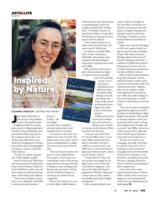
Janet Ruth
Heller
Scanned image of the page. Keyboard directions: use + to zoom in, - to zoom out, arrow keys to pan inside the viewer.
May 19, 2022 (vol. 172, iss. 20) - Image 103
- Resource type:
- Text
- Publication:
- The Detroit Jewish News, 2022-05-19
Disclaimer: Computer generated plain text may have errors. Read more about this.