
MAY 19 • 2022 | 101
W
alking through the halls of
my inclusive and diverse
college campus, it is easy to
feel a sense of belonging and acceptance
no matter where you go. Students
proudly express their own identities
and individualism freely, knowing they
are protected and safe to do so in a
generation that is continuously pushing
for tolerance. However, I began to
realize that a part of my identity that I so
confidently displayed was not only greatly
misunderstood, but also put down by my
fellow peers. This part of my identity was
being a proud Zionist.
I expressed this part of my identity by
wearing my favorite hoodie almost every
week. It was jet black with an Israeli flag
on the back and a gold Star of David
embroidered on the right shoulder. I
began to notice the uncomfortable stares
and negative attention this gathered as
I walked past crowds of students on my
way to class. I thought nothing much of
the looks, until the glances and staring
turned to odd comments and questions
from near strangers. One student waiting
in the same line as me in the cafeteria
caught me off guard, “How could you
support something so hateful?” he asked.
Others commented throughout the day,
“Israel is not a legitimate country” and
“Israelis are oppressors.” Others seemed
to just shy away as these comments were
announced, with not a single student
coming to the defense of Israel.
Strange and misled opinions such as
these took me to question: Does the
younger generation truly understand
what it means to be a Zionist? What
relation, if any, do they have to the Israel-
Palestine conflict that provides them with
such a mindset?
In an effort to understand, I inter-
viewed 90 students from three local
colleges (30 at each campus). Students
were asked if they were familiar with the
term Zionism and if they could provide a
definition of the concept, as well as their
thoughts toward the State of Israel if any.
An overwhelming majority of students,
78 total, were unfamiliar with the term
Zionism and did not understand what
it meant to be a Zionist. However, these
same students who were unfamiliar with
the concept of Zionism were quick to
answer the second question. Forty nine of
the 78 students expressed negative opin-
ions toward the State of Israel.
With further inquiry as to why they
felt the way they did, many students
spoke of influence they have had from
the BDS movement and other anti-Israeli
sentiments. Forty of these students were
unable to provide the correct acronym for
BDS or a precise reasoning for their sup-
port of the movement. As for the students
who were familiar with Zionism, eight
replied with intense opposition of the
State of Israel, three responded with sup-
port and the remaining student expressed
indifference.
Upon viewing these results and wit-
nessing the attitudes expressed during the
interviews, a realization was made that
many students hold anti-Israel sentiment
views without understanding the conflict
or history of the State itself. Many stu-
dents are not exposed to the other end of
the argument in the Israel-Palestine con-
flict as well.
At the end of each interview, I
informed the individual student that I
myself was a Zionist and asked what their
opinion was of me in regards to now
knowing this. The majority of students
responded politely and/or indifferently.
Four students responded surprised with
the statement “But you seem so nice” or
“I wouldn’t have guessed that about you.”
However, most of the remaining stu-
dents responded quite negatively and left
abruptly. This has enlightened me that
representation of Zionist views is near
absent on college campuses and among
the younger generation. For progress to
be made, and for our younger generation
to have a solid base for their beliefs, rep-
resentation of pro-Israeli views should be
brought to light and to the attention of
our youth. @
Caitlin Baird is a third-year linguistics student at
Oakland University. She recently completed Hillel of
Metro Detroit’s Israel Fellowship program.
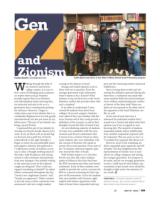
Caitlin Baird and others in the Hillel of Metro Detroit Israel Fellowship program.
Caitlin Bairdl } jewish@eduwriter
Gen
and
Zionism
Scanned image of the page. Keyboard directions: use + to zoom in, - to zoom out, arrow keys to pan inside the viewer.
May 19, 2022 (vol. 172, iss. 20) - Image 101
- Resource type:
- Text
- Publication:
- The Detroit Jewish News, 2022-05-19
Disclaimer: Computer generated plain text may have errors. Read more about this.