

58 | APRIL 21 • 2022
continued from page 57
At the start of the 20th century,
Bulgaria contained a mix of religious
and ethnic groups that had arrived
as invaders, immigrants or refugees.
The majority group, Eastern Orthodox
Christians, lived in relative peace with
Greeks, Turkish Muslims, Roma, Jews
and others. The Jewish population
also came from different waves of
immigration: As Jewish life in other
countries had deteriorated, the ancient
Jewish community that spoke Yavanic
(a Jewish language based on Greek)
was joined by Ladino-speaking Jews
from Spain and Portugal, and Yiddish-
speaking Ashkenazi Jews from the
north.
Located at a crossroads, Bulgaria,
had some independent times but also
was controlled over the centuries by
the dominant Byzantine and Ottoman
empires before it was liberated in 1878.
In the immediate pre-war period,
the king wanted to regain control of
Macedonia (from Yugoslavia), Thrace
(from Greece) and Dobruja (from
Romania), and any other territory
that had belonged to Bulgaria in past
centuries. A deal with Nazi Germany
gave him that opportunity.
As the Nazi party grew and came to
power in Germany, sympathizers in
Bulgaria started their own National
Socialist movement.
When the Germans invaded Poland
in 1939, Bulgaria was officially
neutral, but King Boris III had already
committed to purchasing German arms
and training its officers.
In March 1941, Bulgaria officially
joined the Axis and allowed Germany
to use its territory to attack Greece
and Yugoslavia in April. The victorious
Germans gave Bulgaria these territories,
which were annexed in 1941.
The Jews in these territories were
first counted as part of the Jewish
population in the unified kingdom
but were later denied the right to stay
where they were born and were not
granted Bulgarian citizenship — and
were deported later.
THE JEWS IN BULGARIA
Beginning in 1941, Bulgaria instituted
the classical list of Nazi anti-Jewish legis-
lation. The new laws successively denied
Jews their rights as citizens, their occupa-
tions, their freedom of movement. They
were assigned special taxes and required
to wear the yellow star, and then confined
to ghettos. All Jewish males ages 20-40
were sent to Bulgarian slave labor camps.
The Bulgarian government and the
1942-established Commissariat for Jewish
Affairs planned the next step: deporta-
tions to German death camps.
On Feb. 22, 1943, Bulgaria and
Germany signed a (unique) agreement
to ship 20,000 Jews from cities
throughout Bulgaria. The deportations
began on March 3. Between March
3-12, the Bulgarian army, Gendarmerie
and special forces rounded up some
12,000 Jews from the newly annexed
territories and deported them to
Treblinka, where they were annihilated.
The other 8,000 Jews destined for
deportation were spared due to frantic
efforts of the Jewish community,
who succeeded in getting help from
politicians and the church to delay the
deportation.
Comforty details the efforts that the
Jewish community made to intervene.
Somehow, these efforts resulted in
postponing — but not cancelling — the
transport of Jews from inside Bulgaria.
They got off the death trains. Dimiter
Peshev, vice president of the National
Parliament in Sofia, apparently
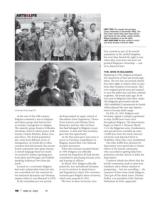
LEFT TOP: The Jewish forced labor
camp celebrates in December 1942. The
first snow meant that soon they will be
sent home for the winter. Jacky’s father,
Bitush Comforty, is on the right.
LEFT BOTTOM: Ika (the author’s mom)
and Vicki Ovadia in Pleven 1943.
ARTS&LIFE
BOOK REVIEW