

MARCH 31 • 2022 | 95
As Monsieur Baudin for the
first eight episodes, Sills’ char-
acter oversees the lavish menus
of railroad tycoon George
Russell (Morgan Spector) and
his social-climbing wife, Bertha
(Carrie Coon) in New York
City, 1882.
Filmed over nine months
during the pandemic, and
under strict safety protocols, The
Gilded Age was shot on location
around New York City, and Sills’
scenes in the servants’ kitchen
were shot at the Elms mansion
in Newport, Rhode Island.
“The series has been fun
to work on. I have often been
tossed things that more main-
stream performers might not
be comfortable with. Creators
often turn to me to create some-
thing from the past, something
quirky — the crazier the better,
”
says Sills who has starred on
Broadway in War Paint, Living
on Love, Little Shop of Horrors and
in his Tony and Drama Desk-
nominated performance as The
Scarlet Pimpernel.
“Doing dialects isn’t new to
me. Besides French, I’ve done
British, Slavic, Southern and
Latin/Hispanic, to name a few.
Working with an accent coach,
studying period manners,
working with a chef coach
— these are all things that an
actor revels in and what I went
to grad school for,” said Sills,
who received his MFA in clas-
sical drama at the American
Conservatory Theater in San
Francisco. “The time period
that the show is set in, with
the war of the classes and
the haves and have nots of
the society at that time, is all
candy for an actor.”
The Zotz fizz candy surprise
came for Sills and viewers in the
season finale. Just days before
the “coming out” debutante
ball for George and Bertha’s
daughter (Taissa Farmiga),
Monsieur Baudin confesses
to George Russell that he isn’t
French after all but, rather, plain
ol’ American Josh Borden from
Wichita, Kansas.
“Having a secret identity is
something that is not difficult
for me to play. I’ve always had
a double identity as a gay Jew
living in a straight, Christian
world. For people who grew
up in the ’70s, if you were gay,
there wasn’t a place for someone
like me in a Conservative syna-
gogue. I knew I had to make my
own way and carry my Judaism
where I went,
” said Sills who
attended Congregation Shaarey
Zedek with his three siblings.
FALLING IN LOVE
WITH THEATER
Sills first found his way to the-
ater after performing in the
talent show at Camp Tanuga in
Kalkaska, Michigan, which was
co-owned by Sills’ uncle, the
late Bernie Friedman, and being
in musicals in high school at
Cranbrook.
“I always got cast as the
gentile. I never looked Jewish
enough or gay enough or
straight enough or sometimes
too gay. Whatever it was, it
wasn’t enough,
” says Sills, who
played a disciple in Godspell
in 1977 the summer before
his senior year at Cranbrook.
“Godspell was a funny show for
me to produce and be in. Listen,
Jesus was a Jew before anything
else, right?”
Sills’ comedic mastery has
served him well in a field that
is becoming much smaller for
Jewish actors.
“If they want to be in per-
forming arts, they’ll be writers,
producers, directors or agents.
You just don’t have enough
power as an actor,” Sills says.
“Most Jews will say it’s too
hard to make your mark and
be competitive. Most Jews are
looking to have a place where
they have control over their
professional destiny.”
To be a successful actor, Sills
advises, you need excellent
comedic timing.
“It’s what’s going on around
you, the lens that you look
through at the world — at your
house, with your relatives. It’s
the oral tradition of telling a
good story — like Milton Berle,
the Marx Brothers or Mort Sahl
did. Then you ask, ‘Is the per-
son a J.K. — Joke Killer?’ Does
the performer know where the
funny is? As a Jew, oftentimes,
you and the writer know where
the funny is,
” Sills says.
“
As a performer, I’m a mem-
ber of two minorities — as a
gay person and as a Jew. It’s a
lot that you carry around — the
fear of being excluded, humili-
ated or beat up,
” he adds. “That
basic tension or fear leads to a
lot of humor.
”
Sills had to go on an acting
hiatus following the death of
his father, Arthur Sills. Douglas
came back to Michigan full-
time from 2007-2010 to run
the family business, First
Holding Corporation in West
Bloomfield, with his sisters,
Claudia Sills and Susan Sills.
At that time, they digitized 45
years’ of documents, which was
particularly helpful during the
pandemic and while filming The
Gilded Age.
“I would be in my trailer
in Newport having a Zoom
meeting with staff and partners
about design elements of the
new ground-up apartments
in Ferndale or reviewing the
resurfacing of a parking lot or
remodeling Ann Arbor apart-
ments or discussing the refi-
nancing of an office building,
and I’
d have The Gilded Age script
out in front of me, highlight-
ed, with the latest changes for
that day’s filming,
” Sills says.
“So, to be able to participate in
both creative and more logical
enterprises going on at the same
time, and at such a high level of
craft, is a profound privilege.
”
For now, Sills is enjoying
his return to performing
and working alongside his
fellow Broadway peers, all
who were unemployed due
to the pandemic. This pause
in the theater world proved
very fortuitous for casting
directors Bernard Telsey and
Adam Caldwell. The Gilded Age
is packed with a roster of Tony
Award winners and nominees,
including Broadway legends
Christine Baranski, Audra
McDonald, Kelli O’Hara,
Nathan Lane, Donna Murphy,
Michael Cerveris and Celia
Keenan-Bolger. Keenan-
Bolger, who also grew up in
Detroit, plays Mrs. Bruce,
the head housekeeper of the
Russell family.
“You never know. There’s talk
that there could be a shidduch
with Chef Borden and Mrs.
Bruce in season two,
” Sills says
with a laugh.
Season 1 of The Gilded Age is now
streaming on HBO Max.
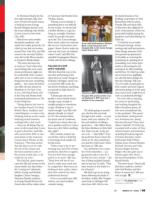
(From left) Sid Friedman, Michael
Bank, Carey Gluckman and
Douglas Sills in the Camp Tanuga
Talent Show, 1977.
Douglas Sills produced the musi-
cal Godspell in 1977 and was a
disciple in the ensemble.