

8 | MARCH 24 • 2022
opinion
Ukraine, Russia and the
Unbearable Lightness of ‘Never Again’
A
fter decades of fearing
that we would forget
the horrors of our
recent past, I am starting to fear
the opposite possibility: that we
Jews remember
our history all too
well but feel pow-
erless to act on its
lessons.
The Russian
invasion of
Ukraine invites
analogies to our
traumatic past. History begs us
to learn from what came before.
These analogies to the past are
never perfect. Seeing analogies
between past and present does
not mean we think that anything
that happened in the past would
be identical to anything happen-
ing in the present.
For comparisons to be useful,
however, they need not be exact.
It is enough for us as Jews to
see familiarity in the past and
resemblance in the present. We
do this to activate our sense of
responsibility, to ask if we have
seen this plot point before, to
figure out how we are supposed
to act in the story to change the
inevitability of the outcome. We
become different people when
we remember, as the past merges
with the present and points to
the choices we might make.
But now: What if we remem-
ber well, but cannot act upon it?
Will Jewish memory become a
prison of our powerlessness?
I grew up believing that
appeasement was just one rung
above fascist tyranny itself,
and at times possibly worse:
Appeasers replace responsibil-
ity with naivete and facilitate
demonic evil even when they
know better. The narrative of
the West juxtaposes Churchill
the hero with Chamberlain the
villain; the philosopher Avishai
Margalit uses Chamberlain as
the archetype of the “rotten com-
promise,
” for making conces-
sions that make people skeptical
of the morality of compromise
altogether. I know that the sanc-
tions regime imposed against
Putin’s Russia and his oligarchs
are the most severe in history,
and still I wonder: What is the
threshold of appeasement, and
will we know if we have crossed
it?
We still debate FDR’s decision
not to bomb the train tracks
leading to Auschwitz. It was a
viable option, and we know this
because Jewish leaders plead-
ed with American officials to
consider it, and they decided
against it. None of us has any
idea whether such a bombing
operation would have succeed-
ed, much less whether it would
have made a dent in the Final
Solution. But our memory of the
story makes us wonder whether
it might have, and it makes us
furiously study the current inva-
sion, seeking opportunities for a
similar intervention.
At the same time, we fear that
we will only know what actions
we should have taken a long
time from now, and that our
children will study such actions
with the same helplessness that
plagues us when we read about
FDR’s decisions.
My great-grandparents came
to America well before World
War II. But I have read about
and feel chastened by America’s
turning away Jewish refugees
during the war. I am in shock
watching the largest and fast-
est-developing refugee crisis
unfolding before us and seeing
our country failing to participate
in a proportionate way — given
our size and economic power
— to the absorption and reset-
tlement efforts. Why do we have
a museum celebrating American
intervention in wartime, as
we do in the United States
Holocaust Memorial Museum,
and why do we have such a
profound educational apparatus
focused on helping Americans
understand how to not be a
bystander, if not for moments
like this?
It is not hard to imagine the
museum that will one day mark
this unfolding atrocity.
Our insistence on memory —
and the belief that it will change
things — never quite works.
This is because the invocation
of memory can be banal, and
because it can pull us apart.
“Never again” is everywhere
now — Meir Kahane’s appeal
to Jewish self-defense became a
rallying cry to prevent genocide,
a banner to fight immigrant
detention, a slogan for schools
and gun control. And what-
ever we wanted the legacy of
the Shoah to be, we have in no
case been successful. American
presidents mouthed these words
seriously even as they failed to
intervene, or intervened too late,
to stop genocides in Cambodia,
Rwanda, Darfur, Syria and else-
where. If the fear was forgetting,
it was unfounded. But remem-
bering and acting on the mem-
ory is something else entirely.
The legacy of our past indicts us
when we can’t carry the former
into the latter.
I never expected — even
watching the politics of memory
pull apart the legacy of remem-
bering for opposing political
ends — that we would shift from
a fear of forgetting to the fear
that comes with remembering.
The past glares at us now, it
revisits us every day in the news
cycle, and I am scared. It is not
because we have forgotten it, but
precisely because we remember
it, and we do not know how to
heed it.
Yehuda Kurtzer is the president of
the Shalom Hartman Institute of North
America and host of the Identity/Crisis
podcast.
Yehuda
Kurtzer
PURELY COMMENTARY
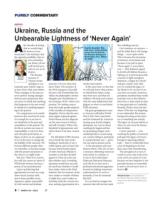
A giant Ukrainian flag
flies from a hotel directly
across the street from
the Russian Embassy in
Washington, D.C., March
10, 2022.
VICTORIA PICKERING/FLICKR COMMONS
JTA