

T
he era of 1930s Detroit was a peri-
od of extreme upheaval. The Great
Depression, the worst economic
disaster in American history, reigned for
the entire decade. Heavily dependent upon
automobile manufacturing,
Detroit felt the ravages of the
Depression more deeply than
any other major city.
Severe economic distress,
however, was just one of
many serious issues facing
Detroiters: there were also
dangerous threats from crime
and racketeering; civic corruption; white
supremacy movements; rampant antisemi-
tism and racial prejudice; and pitched battles
between corporate powers and labor orga-
nizations. As the title of Donald Levin’s new
novel suggests, Detroit was a Savage City.
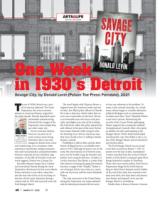
Recently released, Savage City is a histor-
ical novel about Detroit during the Great
Depression. Best known for his seven Martin
Preuss mysteries, Levin takes a deep dive
into the noir side of the city by focusing on
the lives of four main characters during a
critical week in 1932 and a pivotal event: the
Ford Hunger March.
The novel begins with Clarence Brown, a
migrant from the American South and one
of only a few Black police officers in Detroit.
He is also a detective, which makes him an
even rarer commodity on the force. Brown
is an honorable man who faces racial prej-
udice and slights every day of his working
life, both from within the police department
and without. In his part of the story, Brown
faces many obstacles while trying to solve
the lynching of an African American man
that most of police force is willing to falsely
declare a suicide.
Prohibition is still in effect and the distri-
bution of illegal booze is a profitable enter-
prise in 1932. Although its power was on the
wane, the most famous set of Detroit racke-
teers was the Purple Gang. Its founders and
leaders were young Jewish men. Another of
Levin’s characters, Ben Rubin, is a petty thief
who dreams of joining the gang, but instead,
becomes a target of the “Purples.
” Rubin is
not a bad guy, but he sees crime as a career
path out of poverty until he meets Elizabeth
Waters.
The scale of poverty in the United States
during the Depression was unprecedented
and the federal government did not seem
to have any solutions to the problem. To
many, it also seemed uncaring. As a result,
many citizens began to consider alternative
political ideologies such as communism,
socialism and other “isms.
” Elizabeth Waters
is just such a person. Renouncing the
security of her Grosse Pointe upbringing,
Waters supports the communist-initiated
Unemployment Councils. She’s a free spirit,
an idealist, but after participating in the
Hunger March, Waters finds herself jailed
and abused by cops. Ben Rubin is also a vic-
tim of the Hunger March, and a bond devel-
ops between them.
The Ford Hunger March was an actual
event that occurred on March 7, 1932. In
protest over the lack of jobs, unemployed
workers marched from the western Detroit
border to Ford Motor Company’s giant River
Rouge Industrial complex in Dearborn.
There, they were met by police, Ford Service
Department thugs led by Ford’s famous
thug-in-chief, Harry Bennett, and by bullets.
At the end of the clash, four marchers were
dead (one died a few days later) and dozens
were beaten and injured. Levin uses the
Hunger March as a backdrop.
Finally, there is Roscoe Grissom. Grissom
48 | MARCH 17 • 2022
Savage City, by Donald Levin (Poison Toe Press: Ferndale), 2021
Mike Smith
Alene and
Graham Landau
Archivist Chair
ARTS&LIFE
BOOK REVIEW