

18 | MARCH 17 • 2022
ter, water, heat or means of
escape. They work together
through WhatsApp, Telegram
and other cell phone apps, while
raising money to help support
various projects.
“It’s a minute-by-minute type
of situation,
” Feterovich says.
Currently, the network assists
all areas of Ukraine: Kharkiv,
Kyiv, Kherson and regions in
western Ukraine where many
civilians are escaping to get
away from the fighting. The
biggest needs, Feterovich says,
are medical supplies and squar-
ing away logistics for those
who need a place to live once
they safely cross the Ukrainian
border.
“Food is also becoming a
need very fast,
” Feterovich says.
“Where is the world? Why is it
the private citizens that are left
to do this? What is happening?”
PROPAGANDA MACHINE
In Ukraine, the concept of
private property has gone out
the window. Civilians share
vehicles, homes, clothing and
food with strangers, with the
hopes of staying alive. It’s what
Feterovich calls “one united
nation,” where everyone is
ready to protect their country
and even more importantly, its
people.
However, many Ukrainians
have family members in Russia
who struggle to believe that the
war is real.
“
As the Russian propaganda
machine ramps up, the number
one thing that people need
to understand is that it’s on a
whole other level,” Feterovich
explains.
According to her contacts in
Kherson, a Russian film crew
was recently on the ground
filming a fake film. “They’re
pretending that the Ukrainians
are meeting them with flow-
ers,” Feterovich says, “and
they’re distributing them to
citizens. People need to under-
stand this reality.
“Russian people that are in
Russia, they don’t even know
what’s happening,” she con-
tinues. “This is not a war of
the Russian people. This is a
war of the regime. There’s not
a single independent person
reporting in Russia right now.
Everything has been shut
down. Everything.”
UNIMAGINABLE REALITY
As they battle the propaganda,
Feterovich continues to keep
her focus on Ukraine. So far,
she estimates her network has
helped thousands of people —
and plans to help thousands
more.
“Communication is hard,”
she says. “Everything changes
by the minute.”
In recent phone calls beg-
ging for help, Feterovich has
heard horrible stories: One
city has 30,000 people trapped
under rubble in basements;
another has 3,000 children
who can’t get through the pro-
posed green corridor to receive
humanitarian aid. A third city
has just one priest, with one
car, driving civilians out of city
limits to safety.
For the Soviet Jewish immi-
grant, who escaped religious
persecution in the former
USSR, where Jews had limited
opportunity for career and
educational advancement,
Feterovich never thought
something like this could hap-
pen.
“It’s absolutely surreal to me,”
she says. “They can’t get help
fast enough.”
To help, you can donate to the
Ukrainian-American Crisis Response
Committee of Michigan at https://
tinyurl.com/2p8e5hyn; or EO Poland
at https://tinyurl.com/mwtz2mc4.
Russians for
Ukraine
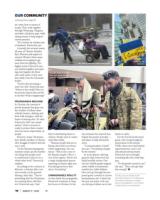
An elderly woman being evacuated.
Hasidic Jews in Dnipro
who are ready to fight
against the Russians.
OUR COMMUNITY
continued from page 16