

4 | FEBRUARY 24 • 2022
essay
Why I Wrote a Jewish
Book about Kidney Donation
G
rowing up, like lots
of idealistic young
people, I always
wanted to be the kind of
person who would change
the world drastically and
for the better — perhaps as
a life-saving
scientist, a
soul-inspiring
musician or a
transformative
political leader.
The problem
was I wasn’t
quite cut out for
those fields and
even those who do make it
big in the public sphere don’t
always have a profound or
positive impact.
So instead, I found myself
on the path of pursuing
wisdom and justice in the
religious realm, where I
learned from the Talmud
that saving a life is like
saving the entire world. Fair
enough, but saving even
one life isn’t exactly easy
either. Becoming a surgeon,
for example, is extremely
difficult, as is being a first
responder.
Then, when I was in my
mid-30s living in Scottsdale,
Arizona, teaching Jewish
values each day, it dawned
on me that I had an
accessible opportunity to
save a life through “altruistic
kidney donation,” meaning
giving a kidney to a stranger.
While the benefits of such an
action are, just as the Talmud
teaches, boundless, I was
overwhelmed with existential
questions. What is my
obligation to protect my own
life? What if, God forbid, my
wife was to lose her husband,
and my kids were to lose
their father? What if my
remaining kidney were to fail
later on?
At that time, I didn’t
have access to the literature
I wanted in order to be
informed. I felt morally
paralyzed by the enormity of
the quandary. So I pledged
that if I were to pursue
this path of donation, I
would afterward create
a resource that could be
helpful to others — to
people considering donating
their kidneys and for those
wanting to be supportive of
their loved ones who wish to
donate.
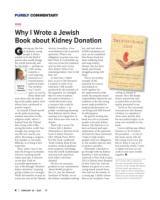
That’s why I wrote The
5-Ounce Gift: A Medical,
Philosophical & Spiritual Jewish
Guide to Kidney Donation
(Ben Yehuda Press, 2022).
For this book, I gathered
Torah wisdom from Jewish
teachers, medical guidance
from surgeons, knowledge
from the world of philosophy
and practical experience
from others who have
donated.
We face an enormous
problem in our communities:
About 90,000 people in
the U.S., per the National
Institutes of Health, are on
the kidney transplant waiting
list, and only about
20,000 transplants per
year can be completed.
Our hearts break for
those suffering from
end-stage kidney
disease, also for their
family and friends
struggling along with
them.
This is yet another
example of the
potential for science
and Judaism to
work together for
the improvement of the
world. By tying the moral
responsibility imbued by our
tradition to the life-saving
power made possible by
medical advancement, we
can bring each field toward
its full purpose.
My goal in writing this
book was not to persuade
people to become kidney
donors. My objective is to
have an honest and open
exploration of the questions
involved for those interested.
I hope to help readers
grapple with our obligations
to one another and our duty
to protect ourselves.
Ultimately, I decided to
go through with my kidney
donation. I had my kidney
removed in New York in June
2015 at Mount Sinai Hospital
in New York City. And my
kidney was given to a very
young Israeli named Yossi,
who had lost his mother at
a young age. I didn’t choose
him as my recipient; I was
willing to donate to
anyone. But I felt deeply
drawn toward him and
accepted him as the first
option presented to me.
“As far as I’m concerned,
every person who donates
a kidney is a superhero,”
Yossi wrote shortly after
his successful surgery in an
essay now included in this
book.
I never did become Albert
Einstein or Yo-Yo Ma or
the president — or one of
the many nurses who do
life-saving work every day.
But to Yossi, it was as if I
had saved the world. I want
to figure out how we can
work to save more worlds
together.
The “5-Ounce Gift” is available for
pre-order through Ben Yehuda Press.
Proceeds will go to Valley Beit Midrash
to further Jewish educational pro-
grams. Rabbi Dr. Shmuly Yanklowitz is
the president and dean of Valley Beit
Midrash. He was recently the Glazer
Institute Scholar at Temple Beth El.
PURELY COMMENTARY
Rabbi Dr.
Shmuly
Yanklowitz