

8 | NOVEMBER 4 • 2021
PURELY COMMENTARY
essay
My Superior (Wis.)
Jewish Genealogy:
From Historic
Baseball Diamonds
to Bob Dylan
I
’m a singer by name and
by trade. I am neither a
sports fan nor an expert on
the subject. But this summer,
after seeing the Associated
Press report that
“no practicing
Orthodox
Jewish player
has made it to
the big leagues,
”
I challenged
sports journalists
to recognize the
most observant
Orthodox Jew to
have played and won the World
Series, Morrie Arnovich.
I never imagined the article
about my hometown heroes
from Superior, Wis., would have
led me to discover Morrie was
also my blood relative.
I didn’t know why I cared so
much about Morrie Arnovich.
After the Forward published my
article, I heard from journalists
and sports fans who questioned
my research and politely cast
doubt on Morrie’s religious
observance, as well as from
some of his family who had
thanked me for correcting the
record.
While I was able to accurately
answer most questions in the
spirit my father, a reference
librarian, would have, I was
surprised to discover that
Arnovich, like the recently
drafted Arizona Diamondbacks
pitcher Jacob Steinmetz,
actually did play in some games
on Shabbat and other holy
days while he was in the major
leagues. But Arnovich still
proudly considered himself to
be an observant Orthodox Jew.
As I dug even deeper, I
found that, according to the
oral history delivered by his
first cousin, Rabbi Alex Hyatt
(originally Arnovich), in the
Litvak shul Agudath Achim
in Superior, the strictest
observance of Shabbat —
shomer Shabbos — was
especially required of the
chazzan. This tradition had
gone all the way back to his
hometown of Wilkomer,
Lithuania.
I intentionally avoided
questioning any of the players’
claims to Orthodoxy. But
from these conversations with
family, journalists and critics,
I learned that while Rabbi
Hyatt undoubtedly expected
everyone to observe the
Sabbath, he also recognized
the reality of ministering to a
remote industrial town where
Jews worked for non-Jewish
businesses and could not always
be shomer Shabbat.
Morrie’s father was a gas
station attendant and his
family observed to the highest
extent that they could under
the circumstances. But Rabbi
Hyatt had to require at least
the minimum requirement
of the chazzan being shomer
Shabbat from all of those who
observed in the community. I
also learned that prior to 1950,
far fewer Jews were shomer
Shabbat than today, including
the Orthodox. Labor laws
eventually allowed for a two-
day weekend and Orthodox
Jews later made greater efforts
to encourage universal Shabbat
observance.
ZIMMERMAN’S BLUES
Responding to my last article,
one journalist felt that the
crossroads between Bob Dylan
and Civil War hero Gen. John
Henry Hammond’s family,
Superior’s founders, was the
most interesting part.
In the last year of his life, my
father helped to research David
Engel’s acclaimed 1997 book,
Just Like Bob Zimmerman’s
Blues. It was Gen. Hammond’s
grandson, music producer John
Henry Hammond II, who was
key in launching Dylan’s career.
The first chapters include
many details on Dylan’s Jewish
upbringing in Minnesota, just
accross Duluth Harbor from
Superior, Wis.
Superior’s Jewish community
was founded by the Kaners
who also were from Wilkomer.
Many of them went by the first
name Shabsie, a Yiddish name.
There were so many Shabsie
Kaners in Superior, they had to
distinguish them by their street
name or other distinguishing
characteristics: “Shabsie
Downtown,
” “Shabsie Connor’s
Point,
” “Shabsie the John Kaner,
”
and so on.
Tugging on that thread, I
learned that Bob Zimmerman
was given the Hebrew
name Shabtai to honor his
grandfather Benjamin David
Solemovitz (Stone), whose
Russian patronymic surname
was taken from his great-
grandfather, Sholem Karon.
Shabtai is the Hebrew form
of Shabsie in Yiddish, which
means “a child of Shabbat.
”
The Shabsie name was
carried down in the family for
generations from Dylan’s sixth
great-grandfather, Girsh Shabsel
Karanovich. The Karanovich
family became the Karons,
Kaners, Canners, etc., and
the Arnovich rabbis were all
cousins who had encouraged
one another to escape Russian
pogroms in the solace of
Superior.
My father never could have
discovered this in his day. His
research as a librarian preceded
the internet. It was before
the digitization of countless
genealogical records, digital
Cantor
Daniel
Singer
Times of
Israel
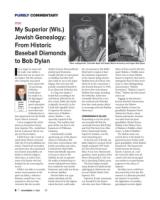
‘New’ mishpachah: Cincinatti Reds left fielder Morrie Arnovich and singer Bob Dylan.
WIKIPEDIA
WIKIMEDIA COMMONS