

62 | SEPTEMBER 2 • 2021
family festival at the farm, with
tractor rides, live music, var-
ious activities and, of course,
apple picking.
Goldstein lives at the orchard
with his wife, Michelle, a
fifth-grade teacher, and their
two teenagers Hyley, 16, and
Manny, 15. Their home is
probably 1,000 feet from where
customers park during their
brief but busy season, begin-
ning in early September and
ending on Nov. 1.
Shortly after I arrive,
Goldstein is eager to show
off his property. He grows
approximately 20 varieties of
apples, everything from the
popular Honeycrisp apples to
McIntosh, Golden Delicious,
Empire, Fuji, Jonathan and
more.
“This is how I get to work,”
said Goldstein, hopping in his
candy red Honda Pioneer ATV
before we tour the property.
As we zip around the orchard,
it becomes apparent that
Goldstein is an endless source
of knowledge regarding apples
and growing them. He explains
how apples are more abundant
at the tops of trees than at the
bottom after a spring frost. He
points out how rubber bands
can pull down limbs, forcing
the trees to bear more fruit,
and spews out countless other
examples of modern growing
techniques during the tour.
“You can’t just let the trees
grow,” he says. “You have to
train them.”
A FAMILY LEGACY
At one point, we stop, and
Goldstein shows off an area of
the orchard that’s particularly
special to him. “I planted those
45 years ago. Want to know
how I know that?” he asks.
“That’s when I graduated high
school.”
Goldstein attended Almont
High School, where he and his
siblings were the only Jewish
students. Although he was
offered a full scholarship to
study agriculture, he declined
and began working full time on
the family orchard. At the time,
his father’s health was declin-
ing. Goldstein started to take
over operations of the farm
purchased by his grandfather
approximately 100 years ago.
His grandparents, Joe and
Ettie Goldstein, emigrated
from Poland in the early
1900s. They initially settled
on Hastings Street in Detroit,
where Joe worked as a peddler.
However, the couple later pur-
chased the farm and moved
out to the country with their
two sons, Gustave and Hyman.
Goldstein’s father, Hyman,
opened Hy’s Cider Mill in the
fall of 1973.
Before the cider mill opened,
the farm was 160 sprawling
acres. Joe split the land in half,
with one section designated for
crops and livestock. The other
half became the apple orchard.
Gustave subsequently took
over the crops and livestock,
and Hyman got the orchard.
While Gustave gave up farm-
ing, Hyman kept his orchard
going, selling his crops at
Eastern Market in Detroit and
opening the cider mill. Their
first cider press made 200 gal-
lons of cider an hour. Today,
the press produces 1,200 gal-
lons in one hour. Goldstein
says it takes approximately 14
pounds of apples to make just
one gallon of cider.
CIDER SEASON
Hy’s is open from 11 a.m.-6
p.m. on Saturday and Sunday
during the fall. Unlike many
other cider mills and U-pick
farms, there aren’t other
activities on-site; there’s no
petting farm, playground or
corn maze. But patrons don’t
seem to care because they
love the cider, donuts and
caramel apples.
Goldstein’s 16-year-old
daughter is often found
helping with the donut oper-
ations. Their donut machine
spits out 180 dozen donuts
— cinnamon or plain — in
just one hour.
In addition to his children
who pitch in when needed,
Goldstein employs two full-
time workers. In the fall, his
staff swells to somewhere
between 30 and 40, with a
dozen picking apples.
This year, Goldstein
expects to harvest between
30% and 40% of his usual
crop due to a late spring
frost. “At least it’s not like it
was in 2012,” he says, refer-
ring to the year when many
area farmers lost their entire
crop.
“The weather makes you
or breaks you,” he says.
“Mother nature will always
be the boss. When you lose
so much of your crop, you
have to make due. There’s no
other choice.
“I love doing this. It’s
rewarding to grow something
because you see it from start to
finish. It’s hard work, but it’s so
gratifying to see what comes
out of that work.”
“IT’S REWARDING TO GROW
SOMETHING BECAUSE YOU
SEE IT FROM START TO FINISH.”
— JIM GOLDSTEIN
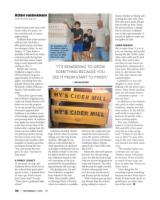
Jim Goldstein with
his children Manny
and Hyley. All those
empty containers
will soon be filled
with fresh cider.
ROSH HASHANAH
continued from page 60