

34 | SEPTEMBER 2 • 2021
S
ynagogues locally and
across the country,
are challenged as they
plan High Holiday services
this year — normally a time
when family and friends,
clergy and congregants pray
and socialize together.
Until the recent spread of
the more contagious Delta
COVID variant, caseloads
had declined considerably
due to vaccination. However,
the new variant is causing
growing concern, even
though the resulting illness
is usually less severe among
vaccinated individuals.
“This is definitely a
challenging time to get
together for any reason,” says
Robert A. Rich, executive
director at Congregation
Shaarey Zedek in Southfield.
The Michigan Board of
Rabbis has been discussing
“best practices,” according
to current Board President
Daniel A. Schwartz of
Temple Shir Shalom in
West Bloomfield. He says
that most local synagogues
have task forces to
establish protocols for their
congregations. Often these
groups include physicians
who are synagogue members.
Executive directors of
about 14 local congregations,
who meet regularly, also have
devoted attention to keeping
High Holiday services safe,
says Alan Yost, executive
director of Adat Shalom
Synagogue in Farmington
Hills. “Our foremost priority
is the health and welfare of
members,” Yost says.
Congregations have sought
input from their members,
including surveys about their
preferences for the High
Holidays. At Temple Emanu-
El in Oak Park, “There was
a great response including
a number of folks who are
being very cautious,” says
Michael Patterson, interim
executive director.
Congregation Beth Shalom
in Oak Park found that
three-quarters of members
wanted in-person services,
based on a survey, says Rabbi
Robert Gamer.
So, most temples and
synagogues are being
cautious as well as creative
— trying to maintain High
Holiday traditions while
keeping congregants safe as
the situation evolves.
To reduce the risk
of transmission, many
congregations are requiring
masks, especially indoors
and for the unvaccinated;
limiting indoor services
to adults and teens; and
conducting family services
outside. Some congregations
are limiting indoor services
to those who are vaccinated,
although verification of
vaccination is not required.
CHOICE OF SEATING
Congregation Beth Ahm
in West Bloomfield will
open the wall between the
sanctuary and the social hall
and offer two seating options
— one in the sanctuary
with regular seating and the
other in the social hall where
participants will be socially
distanced. Masks will be
required in both areas.
At Shaarey Zedek,
ventilation has been
enhanced in the main
sanctuary and the social halls
have been opened up. The
number of individuals on
the bimah will be limited,
according to Rich.
Children under the
age of 13 are not eligible
currently for vaccination,
which is one reason for
special precautions. Outdoor
services are being held in
ROSH HASHANAH
Synagogues respond to COVID variant
Synagogues respond to COVID variant
with options for congregants.
with options for congregants.
Holiday Services:
Indoors, Outside
and Virtual
continued on page 36
SHARI S. COHEN CONTRIBUTING WRITER
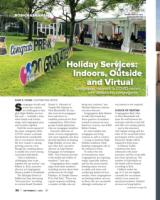
Temple Beth El uses
a tent/pavilion for
some events.
TEMPLE BETH EL